
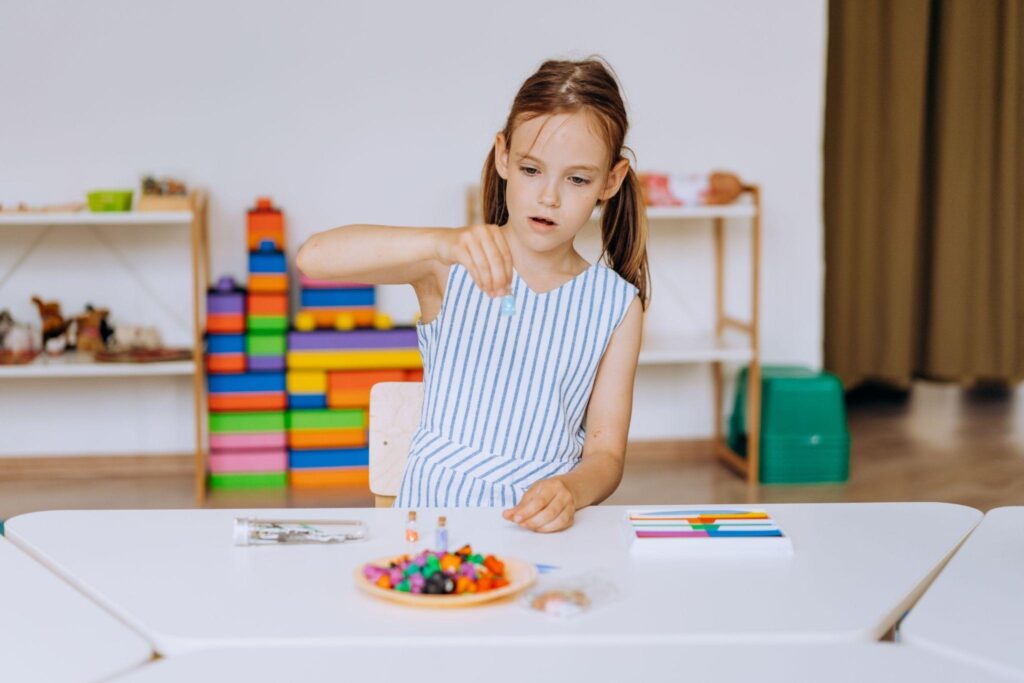
The preschool age, spanning the period between three and five years old, represents a transition from reacting to what is happening in the surrounding environment to the active exploration of it. For example, a toddler would take a toy that is lying nearby, while a preschooler would take it apart and find a new use for its parts. This transition to the deliberate exploration of the world constitutes the key aspect of the formation of cognitive skills in early childhood, which is why the development of curiosity and creativity is such an important issue.
The reasons behind this change and how adults can foster it without controlling and overmanaging the process help understand why the preschool age is a separate period of development and learning and not merely preparation for schooling.
The Importance of Curiosity in the Preschool Age
During the ages between three and five, children continue to actively develop mentally, and curiosity plays a crucial role in this development process. The curiosity of a child makes them explore, compare, and reconsider their perceptions of the world around them. A child wondering why a construction made from the building blocks collapses is subconsciously developing skills of cause-and-effect analysis, patience, and problem-solving.
This is why the term ‘curiosity’ is viewed by educators not as a mere characteristic of some children but as a skill that needs protection and cultivation. Otherwise, it may diminish over time, while if developed well, it may foster flexible and confident thinking.
Creative Thinking in Early Childhood
In early childhood, creativity usually does not show itself as art for art’s sake. Instead, it manifests itself in the story a child makes up while stacking cups and in using a cardboard box to make a boat rather than a house. Such creative solutions of the children are significant because they teach children that there can be several ways to solve the same problem.
Sometimes adults tend to overlook the amount of thinking involved in playing with something as simple as leaves. When a child starts sorting them according to their sizes and colours, they practise the classification. Building a tower and then trying to make it stable teaches them to test the concept of balance using trial and error.
The Influence of the Environment on Curiosity Development
The physical and social environment of the preschool age constitutes a significant influence on the process of the development of curiosity in a child. People skilled in early childhood education are capable of observing and fostering the interests of the child rather than diverting them from what the child is doing and directing them towards the task that was planned in advance. This requires experience and skills.
In Cranbourne and in other parts of Australia, especially fast-growing suburbs of Victoria, the choice of childcare is based increasingly on this issue. When researching childcare in Cranbourne, people start asking what makes the environment truly stimulating and not merely interesting.
Open-Ended Activities and Materials
Materials and activities that do not have a fixed outcome are usually more conducive to the development of creativity in children than toys that can be used only in one particular way. There is no right way to stack blocks or to draw on a sheet of paper; therefore, all the approaches are valid in the eyes of the child.
It is significant because it takes away the stress associated with the necessity of doing everything ‘right’. A child that feels free to experiment is likely to keep doing so, which fosters confidence and creativity in various areas.
The Need for Balance Between Structure and Freedom
Curiosity is equally bad for developing in a completely unstructured environment as for growing under strict control. Preschoolers usually require predictable routines that allow for some degree of spontaneity, such as seeing a bug during the way to the sandpit or becoming suddenly interested in shadows at noon.
An experienced educator incorporates this balance into the plans and does not follow a rigid schedule strictly but treats it as a flexible framework that allows for accommodating the interests of children while providing them with the predictability of what happens next.
Fostering Curiosity at Home
Parents usually ask how to support the development of curiosity outside of the preschool class. The easiest and at the same time most effective approach is to resist the temptation of answering a child’s questions immediately and try to get the child to answer the question themselves. Such a minor adjustment turns the question into a problem-solving situation.
Ordinary activities provide a lot of opportunities for learning. Cooking, gardening, and sorting clothes all include counting, comparing, and prediction, which does not have to be done in a special way; they can be just as educational as anything else labelled as such.