
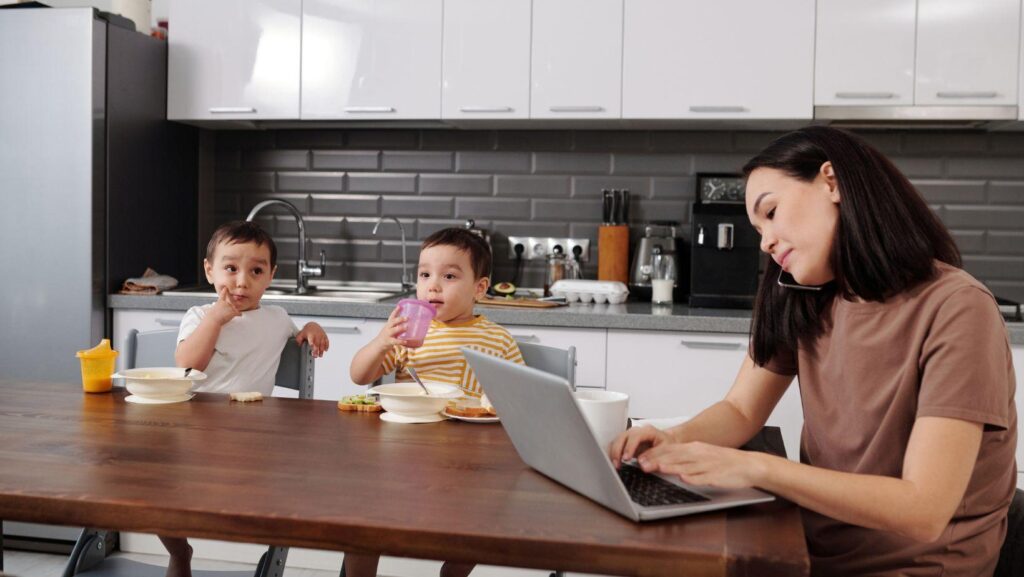
For many parents, the period after children go to bed is the first sustained pause in a day shaped by work, caregiving, household decisions and repeated interruptions. A quieter house, however, does not automatically mean the brain and body are ready for sleep.
Physical fatigue can coexist with continued cognitive and autonomic arousal. Tomorrow’s schedule is still being organized mentally, unfinished work remains active and practical responsibilities continue to compete for attention.
Research in parents reflects this close relationship between daily stress and sleep. McQuillan and colleagues studied 314 mothers of toddlers using actigraphy alongside self-reported measures of stress and sleep. Shorter, later and more variable sleep was associated with higher cumulative stress, while greater stress was also related to longer sleep-onset time and more perceived sleep problems. Because the study was observational, it cannot establish simple causality, but it demonstrates how closely parental load and sleep can become linked.
An effective evening routine for busy parents should therefore do more than create a pleasant atmosphere. It should reduce unresolved cognitive demand, lower unnecessary stimulation and provide a more consistent transition toward sleep.
Pre-Sleep Cognitive Arousal Is Often Part of the Problem
Parenting requires frequent shifts in attention. Work may be interrupted by childcare logistics. Dinner overlaps with homework and planning. Bedtime can involve negotiation, emotional regulation and preparation for the following morning.
Once those tasks end, the cognitive activity associated with them may continue. Sleep research uses the term pre-sleep cognitive arousal to describe processes such as planning, worry, mental rehearsal and problem-solving around bedtime.
For parents, this means the first stage of an evening routine may not be relaxation at all. It may be reducing the amount of information the brain is still attempting to monitor.
Cognitive Offloading May Help Close the Day
One practical strategy is to transfer unfinished intentions from working memory into an external record. Scullin and colleagues tested this in a sleep laboratory study involving 57 healthy adults. Participants were assigned to spend five minutes before bed either writing a detailed list of future tasks or writing about tasks they had already completed.
Sleep onset was measured with polysomnography. Participants who wrote the future to-do list fell asleep significantly faster than those who wrote about completed activities. More detailed lists within the to-do condition were also associated with faster sleep onset.
The study was small and did not specifically involve parents, so it should not be interpreted as a treatment trial for parental sleep problems. Its practical implication is narrower and useful: externalizing unfinished responsibilities may reduce some of the future-oriented cognitive processing maintained around bedtime.
For a parent, five minutes may be enough to record school requirements, appointments, work priorities and tasks that genuinely need attention the next day. Once they are captured, planning should stop.
Autonomic Recovery Is Gradual
Cognitive load is only one component of the transition into rest. The autonomic nervous system continuously adjusts cardiovascular, respiratory and other physiological processes according to changing demands.
Sympathetic activity contributes to mobilization and vigilance. Parasympathetic pathways, including vagal influences on cardiac function, contribute to physiological regulation and recovery. The relationship is not binary.
A parent can be sitting quietly while attention remains oriented toward tomorrow. Some parasympathetic activity may be present while other components of arousal remain elevated. This is why phrases such as “switch off your nervous system” or “reset the vagus nerve” are physiologically imprecise when interpreted literally. Recovery is better understood as a transition.
What Slow Breathing Can Change Physiologically
Breathing is one of the few physiological processes that occurs automatically but can also be modified deliberately. Respiratory rhythm interacts with heart rate, blood-pressure regulation and baroreflex activity.
A systematic review and meta-analysis by Laborde and colleagues examined voluntary slow breathing and heart-rate variability. Across the included research, slow breathing produced consistent changes in several HRV measures associated with cardiac autonomic regulation.
This provides a reasonable physiological basis for using slower breathing as part of an evening wind-down. It does not mean a few minutes of breathwork treat chronic stress or insomnia, and an acute HRV change is not evidence that the nervous system has been reset. For practical use, breathing should remain comfortable and unforced.
Where Auricular Vagus Nerve Stimulation Fits Into the Research
Non-invasive neuromodulation approaches autonomic pathways differently from breathing or meditation. Transcutaneous auricular vagus nerve stimulation, or taVNS, delivers low-level electrical stimulation to selected regions of the outer ear associated with the auricular branch of the vagus nerve.
Electrode location and stimulation parameters matter because vagal innervation is not distributed uniformly across the entire external ear. Research into taVNS now includes stress and sleep.
A 2024 double-blind randomized controlled study recruited 100 adults experiencing chronic stress and sleep disturbance and assigned them across active and sham tDCS and taVNS groups. The taVNS protocol consisted of five consecutive daily 20-minute sessions at 20 Hz. The investigators reported reductions in stress measures and improvements in sleep quality following active intervention, while the study’s specific protocol and population limit how broadly those findings can be generalized.
For parents considering meditation, biofeedback, breathing guidance or wellness devices for relaxation, this distinction matters. Evidence for a physiological method does not automatically prove every consumer product using the same terminology. Stimulation site, electrode design, parameters, safety guidance and actual product evidence should all be considered.
How Data and AI Can Support a Routine Without Taking It Over
Connected wellness devices increasingly add physiological data and software guidance to the evening routine. These tools can be useful when they reduce decision-making rather than create another stream of information to monitor.
Real-time HRV can provide immediate cardiac-autonomic information, but one evening reading is difficult to interpret without context. AI personalization may be more useful when it combines goals, check-ins, session history or longer-term patterns to suggest a routine. A good app + analytics layer can make those patterns easier to review without requiring the parent to interpret every number independently.
Closed-loop stimulation is a different concept. In a true closed-loop system, the device changes stimulation parameters automatically based on physiological feedback. That should not be assumed simply because a product measures HRV or uses AI.
ZenoWell Luna Plus currently combines AI Coach, session history, app analytics, sleep information and on-demand HR and HRV references with its stimulation routines. Its personalization is used for guidance and routine selection rather than automatic parameter adjustment during stimulation. That distinction keeps the software layer useful without overstating what the device does.
|
Digital feature |
Potential value in an evening routine |
Caution |
|
Real-time HRV |
Can show immediate cardiac variability |
A single value is not a stress diagnosis |
|
AI personalization |
Can tailor routine suggestions using context and history |
Recommendations are only as good as the inputs |
|
Good app + analytics |
Can reduce the burden of organizing session data |
More dashboards can become another source of cognitive load |
|
Closed-loop stimulation |
Could adapt stimulation automatically to physiological feedback |
Should be distinguished from data-guided recommendations |
An Evening Routine Can Be Organized Around Three Targets
|
Target |
What needs to change |
Practical options |
|
Cognitive closure |
Unfinished planning and mental rehearsal |
Write tomorrow’s priorities, close non-urgent work |
|
Physiological transition |
Continued activation and muscle tension |
Slow breathing, movement, meditation, structured relaxation technology |
|
Sleep protection |
Continued sensory and cognitive engagement |
Reduce work messages, bright light and stimulating content |
Cognitive Closure
Record anything that genuinely needs attention the following day. Once the essential items are captured, stop reorganizing them. The objective is to reduce working-memory demand, not create another productivity routine.
Physiological Transition
Choose one repeatable practice rather than combining several techniques. That might be slower breathing, gentle mobility, meditation, a warm shower, biofeedback or a structured wearable session. Consistency matters more than complexity.
Sleep Protection
The final part of the evening should require progressively less monitoring and decision-making. For parents trying to work out how to unwind after kids go to bed, the exact routine is less important than this direction of travel: fewer unresolved tasks, fewer decisions and fewer sources of stimulation as bedtime approaches.
“Calming the Nervous System” Needs a More Precise Meaning
Nervous-system language has become common in wellness content. Terms such as “fight or flight,” “dysregulation” and “vagus nerve reset” often describe recognizable experiences but can oversimplify the underlying physiology.
The vagus nerve is an important parasympathetic pathway, but autonomic regulation also involves central neural networks, cardiovascular reflexes, endocrine signaling, respiration and behavioral context. There is no single switch controlling the entire system.
Heart-rate variability deserves similar caution. Vagally mediated HRV can provide information about cardiac autonomic modulation, but it is influenced by breathing rate, posture, exercise, alcohol, illness, sleep and measurement conditions. A single higher value after a breathing or stimulation session does not establish that the nervous system has been fixed.
A more useful concept is autonomic flexibility: the ability to increase activation when circumstances demand it and move toward recovery when the demand has passed. Parents who want a deeper explanation of what current evidence does—and does not—support can review these science-backed ways to calm your nervous system.
Sleep Opportunity Still Comes First
No evening intervention can fully compensate for inadequate opportunity to sleep. This is particularly relevant for parents because the available sleep window may already be reduced by nighttime caregiving, early waking or work schedules.
If that limited window is shortened further by late work, streaming or prolonged phone use, the primary problem may not be inadequate relaxation. It may simply be insufficient time available for sleep. Caffeine timing, alcohol, irregular schedules and evening light exposure can further affect sleep.
A recovery routine should therefore support basic sleep conditions rather than attempt to override them.
Bedtime Procrastination Is a Different Problem
Some parents stay awake despite being tired because the evening is the only part of the day that feels personally controlled. Going to bed can feel like surrendering the one period without demands from work or family. This pattern is often described as bedtime procrastination.
The distinction matters because eliminating all leisure is unlikely to produce a sustainable routine. Reading, watching a program or spending quiet time alone may be restorative. The more relevant issue is whether that activity has a defined endpoint or repeatedly reduces an already limited sleep window.
When an Evening Routine Is Not Enough
Persistent exhaustion should not automatically be framed as a failure to relax correctly. Parental burnout is a broader problem involving severe exhaustion associated with parenting, emotional distancing and a marked change in how the parental role is experienced.
An evening routine may help with sleep preparation without addressing the structural causes of severe overload. When exhaustion remains substantial despite opportunities for rest, emotional detachment increases or ordinary responsibilities become increasingly difficult to manage, broader support may be needed.
That may involve redistributing caregiving responsibilities, modifying workload, strengthening social support or seeking appropriate professional care. Wellness practices can contribute to recovery. They cannot replace changes to an unsustainable situation.
Final Thoughts
A useful evening routine for busy parents should be built around the processes that keep attention and physiology engaged after the main demands of the day have ended.
Research provides several relevant principles. Externalizing unfinished tasks can reduce pre-sleep cognitive load. Slow breathing influences measurable components of cardiac autonomic regulation. taVNS is being investigated as a non-invasive neuromodulation method, with randomized studies reporting changes in stress and sleep under specific protocols. Connected features such as AI personalization and app analytics may help organize a routine, but research-backed technology still needs accurate definitions and realistic claims.
The routine can remain simple: close unresolved tasks, reduce cognitive demand, introduce one repeatable recovery practice and protect the final period before sleep. Parenting inevitably requires periods of high attention. Healthy recovery means preserving the capacity to step down from that level of demand when the day allows it.
References
1. McQuillan ME, Bates JE, Staples AD, Deater-Deckard K. Maternal Stress, Sleep, and Parenting. Journal of Family Psychology. 2019;33(3):349–359. https://pubmed.ncbi.nlm.nih.gov/30762410/
2. Scullin MK, Krueger ML, Ballard HK, Pruett N, Bliwise DL. The Effects of Bedtime Writing on Difficulty Falling Asleep: A Polysomnographic Study Comparing To-Do Lists and Completed Activity Lists. Journal of Experimental Psychology: General. 2018;147(1):139–146. https://pubmed.ncbi.nlm.nih.gov/29058942/
3. Laborde S, Allen MS, Borges U, et al. Effects of Voluntary Slow Breathing on Heart Rate and Heart Rate Variability: A Systematic Review and Meta-Analysis. Neuroscience & Biobehavioral Reviews. 2022;138:104711. https://pubmed.ncbi.nlm.nih.gov/35623448/
4. dos Reis LD, Pereira Generoso L, Pereira GS, et al. Effects of Multisession Prefrontal Cortex tDCS or taVNS on Stress, Perceived Stress and Sleep Quality: A Double-Blind, Randomized Controlled Study. Frontiers in Psychology. 2024;15:1343413. https://pubmed.ncbi.nlm.nih.gov/39346507/
5. ZenoWell. SONA vs ZenoWell: Personalization, Biometrics, App Use, and Costs Compared. 2026. https://zenowell.ai/blogs/start/sona-vs-zenowell-personalization-biometrics-app-use-and-costs-compared