

Caring for a parent from another city, or even from the other side of Ottawa, means living with a low hum of worry that never quite switches off. You call every evening, you visit when you can, and you still wonder what happens on the days in between. The encouraging news is that families manage this successfully every day, and the ones who do it well tend to follow the same playbook. In this guide, we’ll walk through how to tell when your parent needs more support, what the care options in Ottawa actually look like, and how to build an arrangement your whole family can live with.
What you’ll learn:
- The early signs that a parent needs more help than they’re admitting
- How publicly funded home care works in Ottawa, and where the waitlists are
- How to build a care plan everyone agrees on, including your parent
- Ways to protect your own health while you coordinate from a distance
Recognizing When Your Parent Needs More Support
Parents protect their children by minimizing, so the phone will always tell you everything is fine. Trust the house instead of the phone call. On your next visit, look at the fridge, the laundry, the state of the bathroom, and the pill bottles, because those four spots reveal how the quiet days actually go. Missed medications, unopened mail, and a parent who has stopped seeing friends are the classic early signals.
Memory changes deserve special attention. The Alzheimer Society of Canada estimates that 771,939 Canadians are living with dementia, a number projected to reach nearly one million by 2030, and early assessment genuinely changes what families can plan for. Repeated questions, missed appointments, or confusion in familiar places are worth a doctor’s visit now rather than next year.
Understanding Your Home Care Options in Ottawa
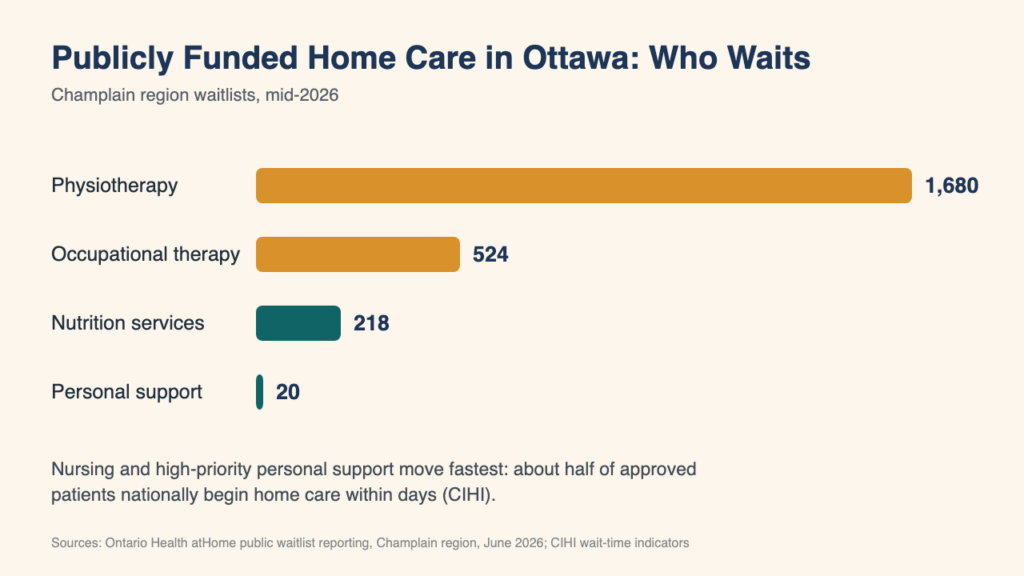
Ottawa families have two broad routes, and most end up blending them. The public route runs through Ontario Health atHome, the provincial agency that coordinates government-funded home care. It serves hundreds of thousands of patients across Ontario each year, and for approved patients, about half begin receiving services within days, according to national CIHI data.
The catch is capacity. Hours are allocated by clinical priority, and the agency’s own public reporting for the Champlain region, which includes Ottawa, listed waitlists of roughly 1,680 people for physiotherapy and over 500 for occupational therapy as of mid-2026. Nursing and high-need personal support move much faster, but a parent who needs regular help with bathing, meals, and companionship may be approved for fewer hours than your family feels safe with.
That gap is where private care comes in. Families comparing providers in the city often look at Integracare’s Ottawa home care services when they want care to start quickly and stay with the same caregivers, since private arrangements let you choose the schedule and scale hours up or down as needs change. Many families use a private provider for the daily support layer while keeping public services for nursing and therapy.
Building a Care Plan Your Parent Actually Agrees With
The fastest way to sink a care arrangement is to build it about your parent instead of with them. Start the conversation from their goal, which research says is almost universal: in the National Institute on Ageing’s 2024 survey, 80% of older Canadians said they want to age in their own homes. Framing help at home as the strategy that keeps them out of a facility usually transforms the discussion.
Agree on the smallest version of support your parent will accept, then let it grow. A cleaner once a week is an easy yes. A companion visit twice a week becomes natural after that, and personal care can follow when trust is established. Write down who in the family handles what, including finances, medical appointments, and being the single point of contact for providers, so nothing important lives in anyone’s head alone.
Coordinating Care From a Distance Without Losing Your Mind
Distance caregiving runs on systems. A shared family calendar for appointments, a group chat that includes the caregiver’s daily notes, and a standing weekly video call with your parent will catch most problems while they’re still small. Ask any professional caregivers involved to flag changes early, since they will often notice a shift in appetite or mobility before a weekend visitor would.
Build your own support in from the start, because caregiver burnout is a documented health risk rather than a character flaw. Schedule real breaks, split duties with siblings honestly, and accept that paying for help with tasks you could theoretically do yourself is often the difference between a sustainable arrangement and a collapse six months in.
Bringing It All Together
Supporting a parent in Ottawa from a distance comes down to seeing clearly, starting small, and building the right team around them. Read the house rather than the reassurances, blend public services with private support where the public hours fall short, and keep your parent in the driver’s seat of every decision that touches their home. Families who set this up early get years of calm instead of a chain of crises, and your parent gets what nearly all older adults say they want: to keep living in the place that feels like theirs.