
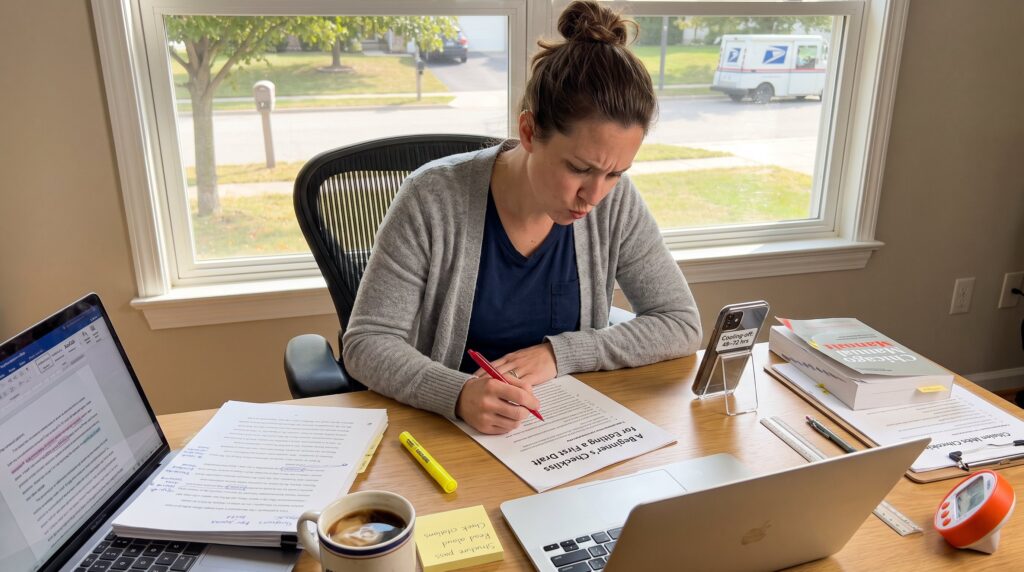
A Beginner’s Checklist for Editing a First Draft gives writers a clear, step-by-step path from messy manuscript to polished copy. This checklist helps writers set revision goals, gain distance, fix structure, sharpen paragraphs and sentences, and finish with consistent formatting and citations. It fits short articles, blog posts, and longer pieces and focuses on repeatable passes so beginners avoid trying to fix everything at once.
Key Takeaways
- Set clear revision goals before editing to maintain focus and reduce unnecessary changes.
- Allow your first draft to rest for 48–72 hours to gain fresh perspective and identify major issues.
- Start editing with structural changes to ensure your main argument or plot is clear and well-organized.
- Refine paragraphs and sentences by clarifying ideas, improving transitions, and varying sentence pace.
- Use a line editing checklist to correct grammar, sharpen word choice, and maintain a consistent voice.
- Finish with a polishing pass to verify formatting, citations, and overall presentation for a professional final draft.
Set Clear Goals Before You Start Revising
State the fact: clarifying goals reduces wasted edits and keeps revision focused. Before any pass, the writer should identify the piece’s purpose (inform, persuade, entertain), the primary audience (novice, parent, manager), and the key takeaway they want the reader to remember. For example, an article aimed at busy parents might target a 700–900 word read with practical tips and a friendly tone. Write a short edit plan with three checkpoints: major structure, clarity and pacing, and final polish. This simple plan acts like a map: it tells the writer which sections to cut, where to deepen examples, and what tone to maintain. Beginners often skip this step and then chase small fixes that don’t serve the main aim. A written plan prevents that. When appropriate, link to related resources: mention a short primer on crafting topics by linking to a clear article outline for writers who need help turning goals into a structural plan.
Take a Cooling-Off Break and Read With Distance
Answer up front: distance reveals problems the writer misses. Letting a draft rest for at least 48–72 hours for short pieces, or one to four weeks for longer manuscripts, helps the writer see repetition, weak scenes, and unclear arguments. During the break, avoid revisiting the text: instead, work on unrelated tasks to reset perspective. On return, change the viewing method, print the draft, use a different font, or read on a phone screen, so sentences read differently. A practical touch: mark only big issues on the first reread (plot holes, missing evidence), then save line edits for later passes. Beginners sometimes rush straight into grammar fixes and then miss the story’s weak spine. For guidance on starting with a blog-friendly workflow, the writer can reference a short guide on getting started writing to pair early drafts with reader expectations.
Structural Pass: Big Picture Fixes (Plot, Argument, Flow)
Direct insight: fix structure before detail or you’ll rework the same sentences twice. In this pass, the editor confirms that the central thesis or story problem is clear and actively drives the piece. For nonfiction, check that each section supports the main claim and that evidence appears where it most persuades. For fiction, ensure each scene raises stakes or reveals character. Use concrete checks: list the top three turning points and verify they appear in order: count paragraphs per section to see balance (e.g., opening should not be five times longer than the middle). Remove or flag material that doesn’t progress the argument or plot. Reorder sections if a logical sequence problem exists, sometimes moving one paragraph fixes a cascade of clarity issues. If chapters or sections feel uneven, create a short revision task list: cut, expand, or move. This high-level pass often trims 5–20% of content and saves hours later.
Paragraph- and Sentence-Level Edits (Clarity, Pace, Transitions)
Key fact: each paragraph should hold one clear idea that supports the main point. Begin by scanning each paragraph and stating its purpose in one sentence in the margin. If you can’t, rewrite or split it. Improve transitions by adding bridge sentences or reordering paragraphs so ideas build logically. Vary sentence length to adjust pace: short sentences quicken tension: longer ones explain nuance. Eliminate one-sentence paragraphs that don’t add movement and trim paragraphs that repeat the same point. A practical tactic: read the end of each paragraph aloud and confirm the next paragraph answers or continues that thought. If it doesn’t, add a linking phrase or rearrange. This pass also spots passive constructions and weak verbs: replace “is/was” with active verbs where clarity benefits the reader. For writers battling blankness or structure early on, pairing this pass with suggestions from simple blog post ideas can spark focused rewrites and sharper paragraphs.
Line Editing Checklist: Grammar, Word Choice, and Voice
Core answer: tidy lines after structure and paragraph passes to preserve energy. Line editing fixes grammar, tightens word choice, and polishes voice. Start with a checklist: correct grammar, standardize punctuation, and fix capitalization. Then remove filler words (that, really, very), swap weak verbs for specific action verbs, and reduce noun strings. Watch voice consistency, if the piece begins conversational, avoid sudden formal phrasing mid-way. Check for repeated words across nearby sentences and for unclear pronoun references: rename the noun if a pronoun confuses the reader. A quick exercise: highlight every adverb and decide if it adds meaning: often it doesn’t. Admit mistakes: many writers find they over-explain early drafts: intentionally cut 10–20% of explanatory lines to tighten voice. When a tool helps, the writer may test clarity-focused editors to flag long sentences and passive voice, but manual judgment should control final choices.
Polishing Tools: Formatting, Citations, and Consistency
Immediate insight: polishing is verification and presentation. Run an automated spell-check, then manually verify proper names, dates, and statistics, autocorrect misses domain-specific terms. Confirm consistent formatting: heading levels, font sizes, bullet styles, and quotation mark usage. Check citation style and bibliography entries for uniformity and accuracy: for web articles, verify that links open and support the exact claim made. Read the piece aloud or on a different device to catch rhythm and awkward breaks. Practical numbers: a final pass can cut stray commas, fix 3–7 citation errors, and normalize heading hierarchy in less than an hour for a 1,200-word article. For writers preparing posts for publication on a platform, use the site’s editorial guidelines and consider peer feedback before final export. If the author aims to publish regularly, pairing publishing steps with material in the writer’s block resource can improve the next draft cycle.
Conclusion
Final takeaway: editing a first draft works best as staged passes, set goals, gain distance, fix structure, refine paragraphs, tidy lines, and polish facts and format. This ordered approach saves time and preserves energy. Beginners who adopt this checklist reduce rework and produce clearer, tighter writing in fewer revisions.