
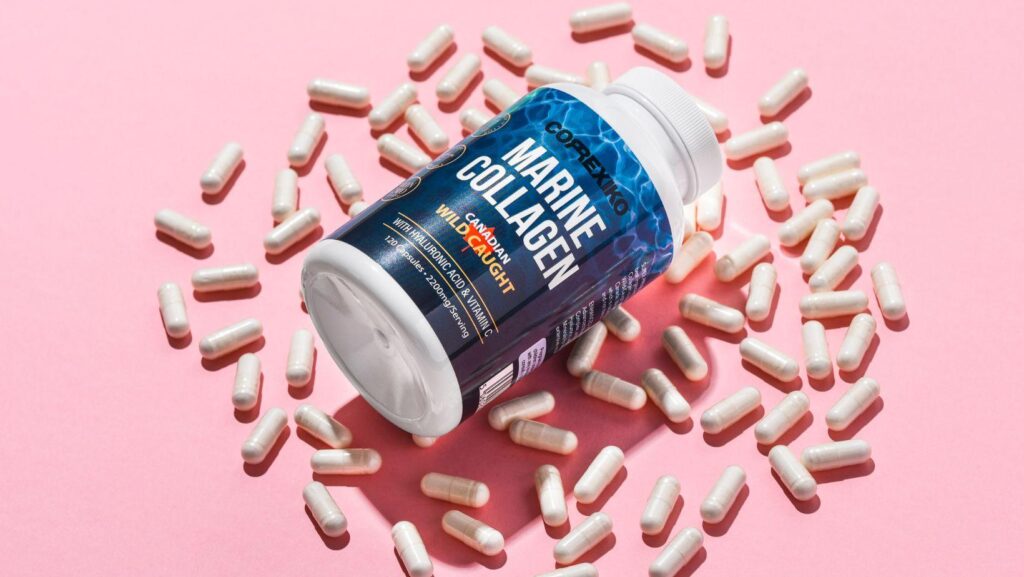
Nadia went into the pharmacy for toothpaste and left forty minutes later with nothing, because the collagen shelf ate her afternoon. Eighteen tubs, all promising smoother skin and easier joints, and no two agreeing on what a serving should be. One was marine, one bovine, one listed something called type II and cost triple. She put every one of them back.
That aisle is doing something clever. It makes the choice feel like a matter of taste, when it is really a matter of specifics: where the protein came from, which type it is, how much you get per scoop, and whether anyone outside the company has checked the label.
So here is the short version of what actually separates one tub from another, in roughly the order it matters.
Where the Protein Actually Comes From
Collagen is an animal protein, so every supplement begins as a hide, a bone, a scale or a shell. Bovine comes from cattle and dominates by volume. Marine comes from fish skin and scales. Porcine turns up in cheaper blends, and chicken sternum is the usual source behind a type II label.
None of these is automatically better, but the source settles a few practical questions. Marine suits someone who avoids beef and pork, and rules itself out for anyone with a fish allergy. Bovine is the cheapest route to a large daily dose. Sourcing detail also works as a proxy for care: a brand that names the country, the herd standard or the fishery expects you to read the label, while a brand that writes premium collagen peptides and stops there is hoping you will not.
Type and Dose Do the Real Work
Collagen gets sorted by where it sits in the body. Type I is the dominant protein in skin, tendon and bone. Type III usually runs alongside it. Type II concentrates in cartilage, the tissue covering the ends of bones where they meet, which is why it appears on joint-focused labels.
Aching joints get blamed on simple wear and tear, but the National Institute of Arthritis and Musculoskeletal and Skin Diseases describes osteoarthritis as a disease in which the structure of joint tissue changes over time, involving cartilage, ligaments, synovium and bone together. No supplement treats that, and a label implying otherwise is telling you about the company rather than the product.
Dose is the other number. Servings on the shelf run from under a gram to twenty or more, and they are not comparable, because type II is dosed far smaller than type I peptides by design. Read the scoop, not the tub. A 500 gram container at 20 grams a serving is 25 days.
What Else Is in the Tub
Most collagen products are not only collagen. Vitamin C appears most often and has a genuine reason to be there, since the body uses it in the steps that build collagen in the first place. Hyaluronic acid, biotin and zinc are common companions. None of that is a problem. The question is whether each one sits at a meaningful amount or a pinch, and the supplement facts panel answers it in about two seconds.
Proprietary blends are where this gets murky: they list a combined weight for a group of ingredients without breaking it out, which lets a formula lead with an impressive name at a trivial dose.
Format matters less than people assume, though it matters for you. Unflavored powder vanishes into coffee. Capsules travel well but take several to match a scoop. Liquids and gummies taste better and cost more per gram.
Verification and the Daily Reality
Supplements are not regulated like drugs, so more of the burden of proof lands on the buyer than most people expect. Third-party verification is the counterweight. The United States Pharmacopeia runs a dietary supplement verification program in which a manufacturer passes a facility audit against current good manufacturing practices, hands over quality control documentation for review, and submits samples for laboratory testing against USP standards, with off-the-shelf testing afterward. In USP's own survey of health professionals, quality assurance marks ranked among the top considerations behind a recommendation.
A seal does not promise a result. It promises that what the label claims is what the bottle holds.
Then comes the unglamorous factor that decides everything. The best collagen supplement is the one still in rotation in week nine, and tubs stall at the back of a cupboard out of friction rather than disappointment. The thinking behind small routines that survive a busy week applies here: attach it to something you already do and keep it visible.
Making the Call
The checklist is short. Name the source. Match the type to what you want from it. Check grams per serving and do the division. Look at what else is in the formula and at what dose. Find a third-party mark. Pick a format you will tolerate on a Tuesday morning.
Nadia went back the next week with that list on her phone and was out in six minutes. Two of the eighteen tubs named their sourcing and carried a verification seal, one of those was type I and III at a sensible dose, and the decision made itself.
Her forty minutes had never been a shortage of options. It was a shortage of criteria, and the aisle will not hand you those. Bring them with you.