
If you've ever found yourself searching for a missing shoe while your child refuses breakfast and you're already running late for work, you're not alone. For many families, weekday mornings can feel like the most stressful part of the day.
Before you've had a chance to fully wake up, you're juggling lunches, school schedules, work responsibilities, forgotten permission slips, and children who may have very different ideas about how quickly the morning should move.
When mornings start with stress, that tension often follows everyone throughout the day. Parents arrive at work feeling frazzled, and children may begin school already overwhelmed or emotional. While occasional chaotic mornings are simply part of family life, constantly rushing from one task to another can leave everyone feeling exhausted before the day has truly begun.
The encouraging news is that calmer mornings don't require a perfect routine or hours of preparation. In fact, the most effective family routines are often built on simple habits that reduce unnecessary decisions and create a sense of predictability.
Research has shown that consistent routines can help children feel more secure, develop independence, and improve their ability to manage emotions. For parents, routines create structure that reduces stress and allows more opportunities for meaningful family connection.
Building a calmer morning routine isn't about achieving perfection. It's about creating a system that works for your family and gives everyone a steadier start to the day.
Start Preparing the Night Before
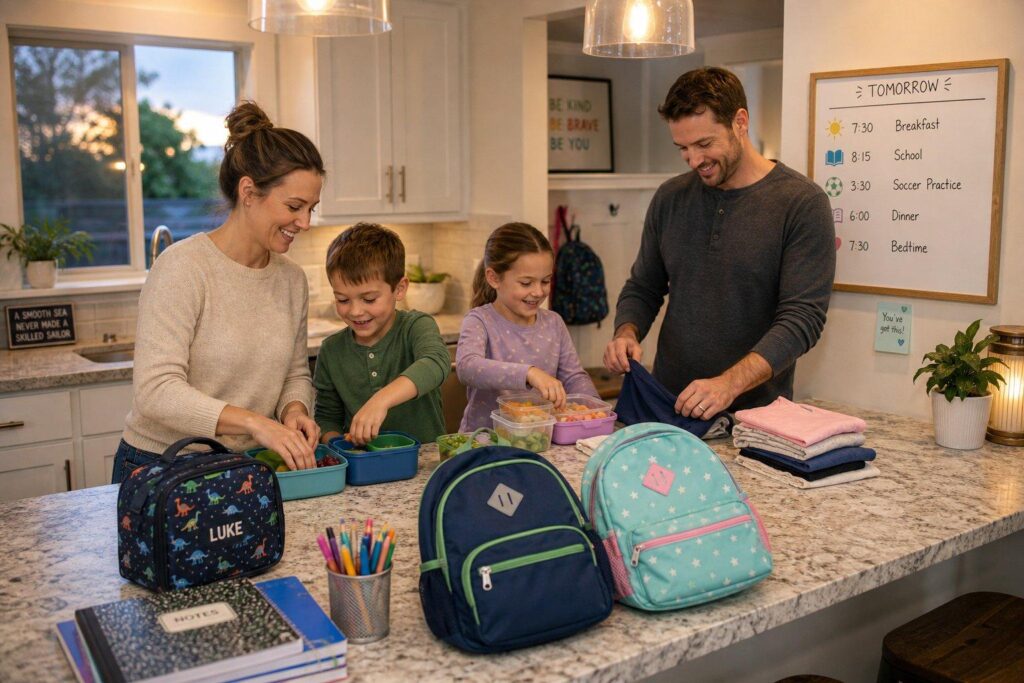
One of the simplest ways to improve mornings is to shift a few tasks into the evening. A small amount of preparation before bed can eliminate many of the common frustrations that tend to appear when everyone is rushing.
Think about the moments that usually create stress in your household. Maybe it's searching for shoes, packing lunches, finding school forms, or deciding what everyone will wear. These tasks often seem small, but together they can consume valuable time and energy during the busiest part of the day.
Spending just ten or fifteen minutes preparing the night before can make a noticeable difference. Laying out clothes, packing backpacks, preparing lunches, and checking the family calendar all help reduce morning decision-making. Instead of scrambling to remember what needs to be done, you can focus on helping everyone transition into the day.
Evening preparation also benefits children. When they know what to expect the next morning, they often experience less resistance and anxiety. Predictability creates a sense of security, especially for younger children who thrive when routines are consistent.
The goal isn't to prepare everything perfectly. Even choosing one task to complete each evening can make mornings feel significantly more manageable.
Simplify Breakfast Decisions
Breakfast is often one of the biggest sources of morning stress because it requires multiple decisions at a time when everyone is still waking up.
Many parents unintentionally create extra work for themselves by treating breakfast as a new decision every day. While variety certainly has its place, weekday mornings are often easier when families rely on a simple rotation of familiar meals.
Children generally respond well to predictable options. When they know what breakfast choices are available, there is often less negotiation and fewer delays. Parents also benefit because they spend less time planning meals and searching for ingredients.
Preparing certain foods ahead of time can further simplify the process. Overnight oats, hard-boiled eggs, pre-cut fruit, or smoothie ingredients prepared in advance can save valuable minutes during busy mornings.
More importantly, a consistent breakfast routine creates stability. Children begin to understand the flow of the morning and what is expected of them. That predictability helps reduce stress and encourages greater cooperation as everyone moves through the routine together.
Understand Why Routines Matter for Children's Development
Many parents view routines as organizational tools, but their benefits go far beyond helping families stay on schedule.
Children thrive when they know what comes next. Predictable routines help create a sense of safety and stability, which are important foundations for emotional well-being. When children understand the sequence of events in their day, they spend less energy worrying about what will happen and more energy focusing on learning, growing, and participating.
Morning routines also create opportunities for children to build independence. As they repeatedly practice tasks such as getting dressed, brushing their teeth, or preparing their belongings, they gain confidence in their abilities. Over time, these small responsibilities help develop self-reliance and problem-solving skills.
Consistent routines can also reduce power struggles. Many conflicts occur when expectations are unclear or constantly changing. When children know what happens each morning, there is less need for repeated reminders and negotiations.
While no routine will eliminate every challenge, a predictable structure provides children with a framework that supports both emotional security and healthy development.
Create Simple Systems Around the Home
Morning stress often comes from searching for things rather than completing tasks.
A backpack disappears. Shoes aren't where they're supposed to be. Water bottles go missing. Individually, these problems seem minor, but together they can quickly create frustration and delay.
Creating designated spaces for commonly used items can help eliminate much of this confusion. A launch area near the door for backpacks, shoes, jackets, and keys gives everyone a consistent place to find essential items. Similarly, organizing breakfast supplies and lunch materials in predictable locations can reduce unnecessary movement around the house.
Parents may also find that creating a dedicated beverage station or investing in a coffee setup for busy mornings helps simplify one of the first tasks of the day, reducing small frustrations that can add up during the morning rush.
These systems also encourage children to participate more independently. When they know exactly where items belong, they can contribute without constant guidance from adults.
The key is consistency. A simple system used every day is far more effective than a complicated organizational strategy that is difficult to maintain.
Build Extra Time Into Your Schedule
One of the most effective changes a family can make is adding a small buffer to the morning schedule.
Many families operate on a timeline that assumes everything will go perfectly. Unfortunately, family life rarely works that way.
Children have difficult mornings. Spills happen. Homework gets forgotten. Someone suddenly remembers a special school project just as it's time to leave.
Building even ten to fifteen extra minutes into the morning can dramatically change how these situations are handled. Instead of responding with panic or frustration, parents have the opportunity to address problems calmly.
This buffer also benefits children emotionally. When adults remain calm during unexpected situations, children learn valuable lessons about problem-solving and emotional regulation. They see that mistakes and setbacks can be managed without turning into crises.
The purpose of extra time isn't to accomplish more tasks. It's to create space for real life to happen without overwhelming the entire household.
Make the Routine Easy for Children to Follow
The most successful routines are often the simplest ones.
Children are far more likely to follow a routine when they can understand it independently. Rather than relying on constant verbal reminders, consider creating visual cues or simple step-by-step expectations.
For younger children, a visual chart can provide gentle guidance throughout the morning. For older children, a consistent sequence of tasks may be enough to build familiarity and independence.
It's also helpful to keep expectations age-appropriate. A preschooler may be responsible for putting on shoes and carrying a backpack. An older child may be capable of preparing breakfast or packing lunch.
Allowing children to take ownership of small responsibilities builds confidence and reduces the burden on parents. Over time, these habits become automatic, making mornings smoother for everyone involved.
Protect One Calm Moment Before the Day Begins
In the middle of getting everyone ready, parents often forget about themselves.
Yet one of the most powerful ways to create a calmer morning is to intentionally protect a small moment of peace before the day becomes busy.
This doesn't require an elaborate self-care routine. It might be enjoying a cup of coffee while it's still hot, sitting quietly for a few minutes, stretching near a window, or simply taking several deep breaths before getting out of bed.
These moments matter because children are highly influenced by the emotional atmosphere around them. When parents begin the day feeling grounded and centered, that calmness often spreads throughout the household.
A brief pause can help shift your mindset from reacting to responding. Instead of feeling immediately pulled in multiple directions, you begin the day with greater intention and patience.
Many parents believe they don't have time for these moments. In reality, even sixty seconds of intentional calm can make a meaningful difference.
Adjust Instead of Starting Over
No family routine works perfectly every day.
When mornings become difficult, it's easy to assume the entire system needs to be replaced. In most cases, however, only one or two areas need adjustment.
Pay attention to recurring challenges. Perhaps breakfast consistently takes too long. Maybe getting dressed creates conflict. Maybe everyone struggles to leave on time.
Rather than redesigning everything, focus on improving the specific area that causes the most frustration. Small changes are easier to implement and more likely to become lasting habits.
Flexibility is also important. Children grow, schedules change, and family needs evolve. A successful routine is one that can adapt over time while still providing structure and stability.
Final Thoughts
Calmer weekday mornings rarely happen by chance. They are usually the result of small, intentional habits that reduce stress and create predictability for the entire family.
Preparing the night before, simplifying decisions, creating organized systems, and allowing extra time can transform the way mornings feel. Beyond improving efficiency, these routines help children develop independence, emotional resilience, and confidence.
Most importantly, a calmer morning creates more opportunities for connection. Instead of spending the first part of the day rushing from one problem to the next, families can begin the day with greater patience, cooperation, and presence.
You don't need to overhaul your entire routine overnight. Start with one small change and build from there. Over time, those small adjustments can create mornings that feel less chaotic, more intentional, and far more enjoyable for everyone involved.