
Plant-based supplements have moved from specialty shelves into everyday routines. If you have been comparing fruit powders and juices, you may have seen Queen Garnet plum, a deep-purple Australian fruit sold as nectar, plain powder, and blended sachets.
Parents tend to have two practical questions: What does the evidence show, and is the product appropriate to keep around children? Research on specific health benefits remains limited. Household use depends on factors such as sugar, serving size, ingredients, and who will consume it.
It also helps to understand the regulatory backdrop. In the United States, products sold as dietary supplements are not reviewed or approved by the FDA before reaching the market. Buyers need to examine labels and marketing claims carefully.
Key Takeaways
- Queen Garnet is a plum, not a medicine. It was bred in Australia through conventional, non-GMO cross-breeding and is naturally rich in pigments called anthocyanins.
- The evidence is still developing. A 2025 randomized trial found that the juice provided no added cognitive benefit beyond a memory program in older adults with mild cognitive impairment.
- Format affects serving size and sugar intake. Ready-to-drink nectar contains the fruit’s natural sugars, while powders offer more control over portions and food pairings.
- Standard pediatric guidance still applies. The American Academy of Pediatrics recommends no fruit juice for infants under 12 months and sets limits for older children.
- International orders have added costs. Prices in Australian dollars, postage, and exchange rates should all be included in your estimate.
What Queen Garnet Actually Is
Queen Garnet was developed by the Queensland Department of Agriculture and Fisheries using traditional cultivation and cross-breeding rather than genetic modification. In 2010, the department granted Nutrafruit an exclusive worldwide license to commercialize the variety. That helps explain why the same fruit appears in several consumer product formats.
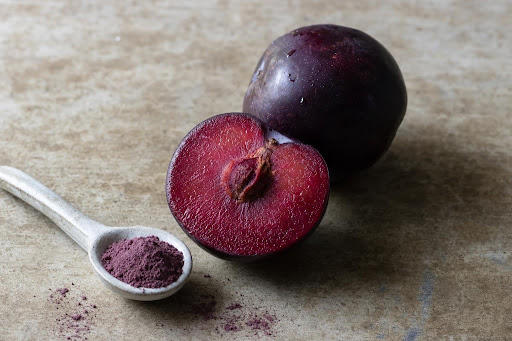
Interest in the fruit centers on anthocyanins, natural pigments that give many dark fruits their color. Analytical profiling published in 2024 found that Queen Garnet plum extract is dominated by two anthocyanins: cyanidin-3-O-glucoside and cyanidin-3-O-rutinoside. This describes the fruit’s chemistry, not its effects in the human body.
What the Research Does and Does Not Show
A useful recent data point comes from a 2025 randomized trial involving older adults with mild cognitive impairment. Participants who drank Queen Garnet plum juice while completing a memory training program did not experience additional cognitive benefits compared with participants completing the program alone. Researchers reported that each 250 mL bottle provided approximately 145 to 201 mg of anthocyanins, measured as cyanidin-3-glucoside equivalents.
Broader research on anthocyanin-rich foods has identified possible effects on vascular and cardiometabolic markers. Results vary by study design, dose, product, and participant group, however. For healthy adults balancing work and family life, the practical conclusion is modest: Queen Garnet is a fruit-derived product with measurable anthocyanins, not a proven treatment. Be cautious with marketing that suggests otherwise.
Formats That Fit a Busy Day
The Australian brand PurQ sells Queen Garnet as ready-to-drink nectar, plain plum powder, and blended sachets. The formats require different levels of preparation and make it easier or harder to control portions.
The nectar is sold in packs of ten 250 mL bottles for $60 AUD and is made almost entirely from Queen Garnet plum puree. It requires no preparation, but it also delivers the fruit’s natural sugars in liquid form.
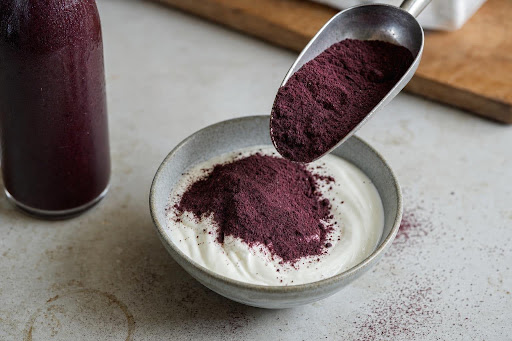
Plain powder is more flexible. It can be stirred into oats or yogurt or added to a smoothie, allowing you to choose the serving size and accompanying ingredients. Pairing it with a meal containing protein or fat may also make it more filling than drinking nectar by itself.
Blends offer additional ingredients in premeasured servings. PurQ’s Gut Care Powder comes in 15 single-serve 10 g sachets for $60 AUD. Queen Garnet plum powder accounts for 40% of the blend, which also contains inulin, baobab, green banana, raspberry powder, silica, and Bacillus coagulans at 5 billion colony-forming units per serving. Its separate Night Time Restore blend combines Queen Garnet with sour cherry. The company describes it as non-habit-forming and free from synthetic melatonin, but that description should not be treated as evidence of better sleep.
Label Reading in Three Checks
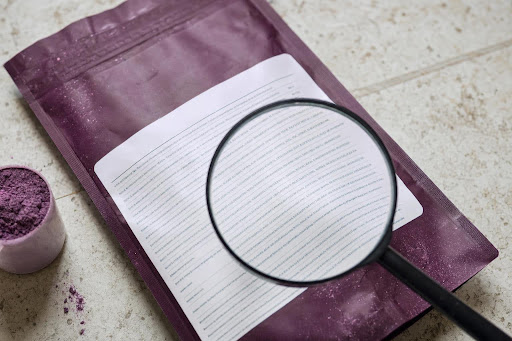
Products in this category can look similar while containing different ingredients and serving sizes. Three quick checks can make comparisons easier.
- Review ingredient order and percentages. Check whether the named fruit appears near the top and whether the label states its share of the blend. A figure such as 40% is more informative than a fruit image on the front of the package.
- Check probiotic strains and amounts. If a product contains a probiotic, look for the full strain name and the number of colony-forming units per serving rather than a general reference to “cultures.”
- Confirm added ingredients and serving size. Look for sweeteners, preservatives, and other additions. Then compare the amount in one serving before judging prices across products.
Kids, Juice, and Sugar
A fruit-based product purchased for an adult routine is not a substitute for appropriate drinks for children. The American Academy of Pediatrics recommends no fruit juice for infants under 12 months. Its school beverage guidance limits 100% fruit juice to no more than 8 ounces per day and encourages families to reduce sugary drinks generally.
Two everyday concerns sit behind this guidance. Sipping sweet liquids throughout the day increases the time teeth are exposed to sugar, while juice may displace appetite for meals or milk. If older children ask for nectar kept in the refrigerator, treat it like any other 100% juice: offer a small portion with a meal rather than allowing frequent sipping.
Safety Notes Worth Pausing On
Because dietary supplements are not approved before sale in the United States, careful label review matters. Speak with a clinician or pharmacist before using a concentrated fruit or botanical product if you take prescription medication, manage a medical condition, or have a history of food allergies.
Pregnancy and breastfeeding also call for caution because safety data for many concentrated plant products are limited. “Natural” does not mean risk-free, and no supplement is suitable for every person. Stop using a product and seek medical advice if you experience an unexpected reaction.
Cost, Shipping, and Subscriptions
PurQ operates an Australian storefront, so its listed prices are in AUD and are not converted for U.S. buyers. A box of nectar or Gut Care sachets is listed at $60 AUD. To estimate the real cost, include currency conversion, international postage, and how often you expect to use the product.
Orders ship internationally through Australia Post, with timing dependent on destination and season. Free shipping applies within Australia to orders of at least $96 AUD, and Australian subscriptions also ship free. U.S. buyers should not assume those offers apply to their orders.
Subscription discounts are listed as 20% for delivery every 15 days, 15% every 30 days, and 10% every 45 days. The plans have a two-order minimum before cancellation, so check the total commitment before subscribing.
Other Anthocyanin-Rich Options
If international shipping, price, or format does not suit your household, anthocyanin-rich fruits are widely available closer to home. Options include tart cherries, blueberries, blackcurrants, and aronia berries. The same cautions apply: consider sugar in juices, question claims that exceed the evidence, and do not assume a product is appropriate for children.
A Practical Way to Try It
If you decide to try Queen Garnet, keep the test simple. Begin with the labeled serving, pair it with a meal, and use it for a defined period before deciding whether it fits your routine. A powder may make portion control easier than a full bottle of nectar.
Pay attention to what you actually notice rather than what the marketing suggests, and stop if you experience an unwanted effect. Products such as those sold by PurQ are best viewed as optional, food-derived additions to a routine, not as treatments or substitutes for a balanced diet.