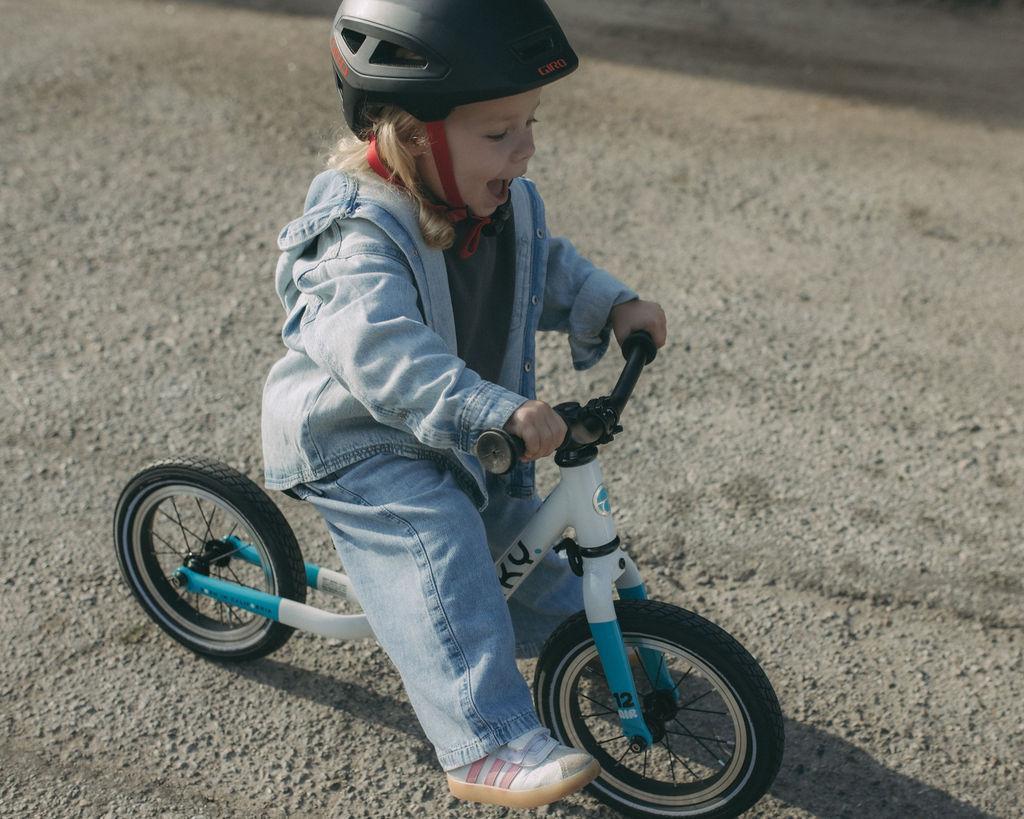
Hardly anyone thinks about pavement texture the first time a toddler pushes off on a balance bike. Parents are watching for wobbles, not slope. But where that first ride happens does more to decide whether the excitement lasts than the bike itself does: a patch of loose gravel, a driveway with cars backing in and out, or a slope that’s just a little too steep can turn a confident two-year-old into a bike-shy one by the end of a single afternoon.
This guide covers three things together because they can’t really be separated: the location itself, the gear that makes a fall forgettable rather than frightening, and the bicycle fit that determines how much control a child actually has once they’re rolling. Skip any one of the three and the other two matter less; kids notice the gaps even when adults don’t.
Is a Toddler Actually Ready to Start?
Age is a rough guide at best: some toddlers are ready at 15 months, others closer to three. A few signs matter more than a birthday:
- Can stand unsupported for a few seconds without holding onto furniture or a parent’s hand.
- Shows real interest in the bike itself — climbing on it, pushing it around the living room, asking to go outside with it.
- Can follow one simple instruction (“stop,” “wait”) most of the time, even if not perfectly.
- Is comfortable being outside off-leash or on a stroller strap, at least in a fenced or enclosed space.
Most kids show more than one of these signs well before they show all of them, and that’s normal. These don’t all need to line up at once, either — a toddler who isn’t quite there yet doesn’t need to wait for a milestone chart. A few short indoor sessions standing over the frame, with no pressure to actually ride, tend to answer the readiness question faster than watching for a specific age.
Toddler Balance Bike Safety Starts With the Right Setting
A balance bike skips pedals and brakes entirely, and gears never enter the picture either: the child alone controls speed and direction. That’s exactly why balance bikes work so well for learning to steer and lean before pedaling enters the picture. It’s also why the setting has to do more of the safety work than it would for an older kid on a bigger bike: at walking pace, a toddler doesn’t yet have the reflexes to correct for a surface problem the way a more experienced rider would, so the environment ends up compensating for a skill gap that hasn’t closed yet.
Pediatric guidance on bicycle safety consistently emphasizes a point that surprises many parents: many injuries occur in driveways, on sidewalks, and on shared bike paths, not on busy streets. That tracks: a driveway is only as safe as its sightlines and its traffic pattern, and a sidewalk is only as safe as its surface and its crossings. Shared paths add another variable: other kids on bikes and scooters, all moving at their own pace and not always paying attention to a much smaller rider nearby.
What Actually Makes a Surface Safe — and Why
Not every paved area is created equal, and the reasons come down to physics as much as common sense. A balance bike has no freewheel and no momentum to speak of at toddler speed, so anything that interrupts the front wheel’s contact with the ground gets amplified rather than absorbed:
- Flat and even. A slope an adult wouldn’t register can drift a two-year-old toward a curb or a parked car, because there’s no braking system to correct course; steering is the only tool available, and steering takes longer to learn than balance does.
- Free of loose material. Gravel, sand, wet leaves, and standing water all reduce the front wheel’s grip, so it can turn without the bike turning.
- Wide enough to wobble in. Young riders steer in broad, uneven arcs before they steer in straight lines, so a narrow sidewalk or path leaves no margin for the arc itself.
- Free of steep grades. With no brake, any real downhill turns “ride” into “roll,” and speed builds faster than a toddler can process.
Open water (a pool, pond, or drainage ditch near the practice area) is a separate category of risk from surface quality. It deserves its own rule rather than getting folded into “avoid it if the ground looks bad”: treat any body of water as an automatic boundary line, regardless of how flat and dry the pavement around it looks.
Why Balance Bikes Work Before Pedals Do
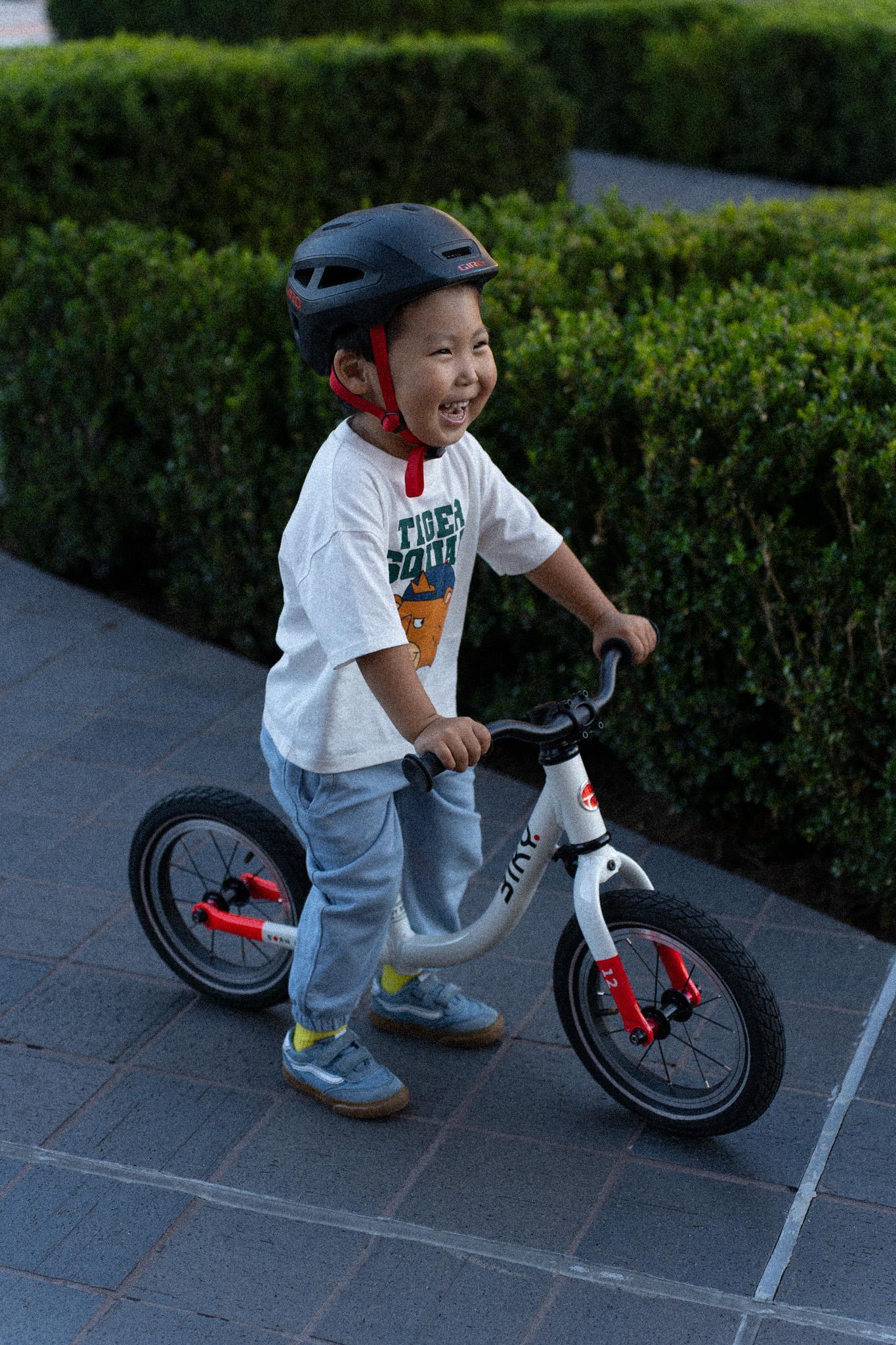
Skipping training wheels for a balance bike isn’t just a trend: it changes what a child practices first. A bike with pedals asks a child to juggle pedaling and steering while also keeping their balance; a balance bike removes pedaling from the equation entirely, so kids learn to steer and lean with both feet available as a safety net, and only add pedaling once that instinct is already there. That sequencing is a big part of why, once a child is ready, the switch to a pedal bike often takes only five to ten minutes rather than weeks of relearning.
For kids specifically, the low seat height and simple frame mean falls happen from a shorter distance and at a slower speed than on a bike with training wheels, which tend to tip sideways rather than settle down onto both feet. A young rider on a balance bike can put a foot down at the first sign of trouble instead of waiting for a wheel to catch or a pedal to jam; a difference that makes watching parents noticeably less anxious once they’ve seen it happen a few times.
None of this makes a balance bike foolproof, and kids still fall the way any beginner on any bicycle does. What it does is shift most of the actual risk back onto the same three factors the rest of this guide covers: the surface a child rides on, the gear they’re wearing, and how well the bike itself fits.
Driveway, Sidewalk, or Bike Park? Comparing Common First-Ride Locations
Not every family has a bike park or a quiet cul-de-sac nearby. Here’s how the realistic options tend to compare:
|
Location |
Surface |
Traffic Exposure |
Room to Roam |
Best Suited For |
|
Home driveway |
Usually smooth, but often sloped |
Low, but not zero (reversing cars) |
Narrow |
Very first sessions, adult standing at the street end |
|
Quiet cul-de-sac |
Smooth pavement |
Low |
Wide |
Early sessions once basic steering is there |
|
Sidewalk (residential) |
Smooth, interrupted by curb cuts |
Low to moderate (pedestrians, crossings) |
Narrow to moderate |
Once steering is reliable enough to hold a line |
|
Bike park or paved trail |
Even to moderate |
Low to moderate (other riders) |
Wide |
Building confidence over longer stretches |
|
Empty parking lot (off hours) |
Very smooth |
Low, if truly empty |
Very wide |
Practicing turns and stops with no curbs |
|
Grass lawn |
Uneven, slower rolling |
None |
Depends on yard size |
Very cautious first-timers (see below) |
Families without a driveway or yard aren’t out of options. A quiet stretch of sidewalk at a low-traffic time of day, an empty section of a school parking lot on a weekend, or a covered mall walkway before opening hours can all work; the criteria above (flat, clear, wide, low-traffic) matter more than which category of location they happen to fall into.
Common Mistakes During Practice Rides
A few patterns show up often enough among kids at this age to call out directly:
- Starting on a hill “because it’s more exciting.” Momentum without brakes is the opposite of confidence-building for a first-timer.
- Skipping the hazard sweep. A hose, a forgotten toy, or a pet in the path causes more falls than bad pavement does.
- Reusing a hand-me-down helmet. A helmet that “fits” an older sibling was built for a different head-injury pattern. See the helmet section below.
- Buying a bike “so it lasts longer.” A frame that’s too big or too heavy undoes almost everything else on this list; fit matters more than growing room.
The Safety Gear That Actually Matters at This Age
A helmet is the one non-negotiable piece, covered in more detail further down. A few other items matter specifically because of how kids fall at this age: not fast, but often, and usually sideways or forward onto outstretched hands.
Elbow and knee pads absorb the scrapes that come from exactly that kind of low-speed tip-over; they’re a minor daily hassle worth keeping. Closed-toe shoes matter for the same reason sandals don’t: a toddler’s foot is close to the ground and close to the front wheel, and bare toes or open sandals take the brunt of a stub or scrape that sneakers would deflect. Bright clothing is a minor but real factor: a low-to-the-ground rider in muted colors is genuinely harder for a reversing driver or another cyclist to spot than the height difference alone would suggest.
Give the Bicycle Itself a Quick Check
A child’s safety also depends on the bicycle holding together the way it’s supposed to. When buying, check ASTM F963 (the U.S. toy-safety specification covering ride-on toys), since it specifically tests for sharp edges, fastener risk, and tip-over resistance rather than just general build quality. As of August 2026, that’s a reasonable baseline for judging any bicycle in this category.
Beyond the standard itself, a short physical check before rides catches the problems a standard can’t, and kids often enjoy helping with it once they’re old enough to hold the pump:
- No sharp edges or exposed bolts on the frame, fork, or seat clamp.
- Tires free of cracks, with air-filled tires properly inflated.
- Saddle and handlebars locked firmly — a firm twist by hand should reveal any slippage before a ride does.
- No bolts that have worked loose since the last ride.
It’s worth checking SaferProducts.gov occasionally for open recalls on a specific model, particularly for a secondhand or hand-me-down bike whose history isn’t fully known.
Choosing a Balance Bike: Seat Height, Fit, and How Much It Weighs
Fit starts with the seat. At its lowest setting, a child should be able to sit with both feet flat on the ground (not on tiptoe) since that’s what lets them push off and catch themselves without stretching. As a rule of thumb, seat height should be at or just below inseam length, and an adjustable seatpost buys a season or two of extra use as a child grows.
Weight matters just as much as height. Many pediatric cycling guides lean on a rough rule that a balance bike shouldn’t be heavier than about 30% of a child’s body weight — past that point, a toddler starts wrestling with the bike rather than riding it, which slows down the balance-and-confidence progress the bike is supposed to build. A 6.4 lb frame (how much the Biky 12 itself actually weighs, verified against its product listing as of this writing) stays comfortably under that threshold for most children in its stated 1.5–4-year range. In contrast, a bulkier steel-frame bike closer to 10 lb often won’t.
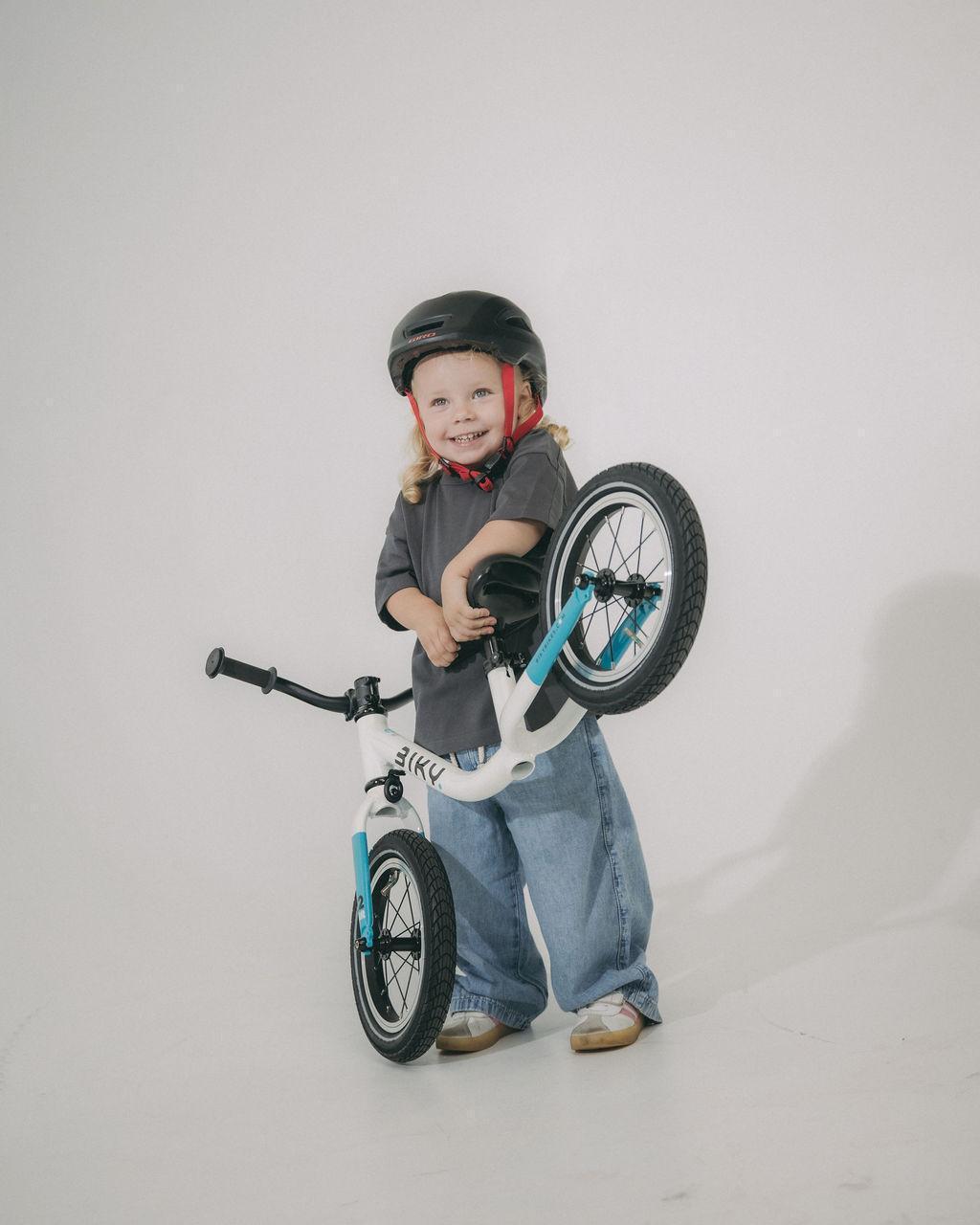
A well-sized 12-inch balance bike with a low step-through frame and a built-in steering limiter gives young riders enough control to handle a bumpy seam or a tight corner without the front wheel jackknifing out from under them. A bicycle that’s too heavy or too tall undoes much of the careful location scouting above, since the child ends up fighting the bike instead of reading the surface; age and inseam matter here more than a birthday alone would suggest. Kids grow fast at this age, so it’s worth rechecking seat height every couple of months rather than assuming last season’s setting still fits.
Two smaller details are worth checking too. Air-filled tires cushion small bumps better than solid foam tires, which stay puncture-proof but transmit more of the terrain straight into small hands. And while a hand brake isn’t necessary in the first weeks, it’s a genuinely useful feature for an older toddler getting ready to move toward a pedal bicycle, since practicing the motion now makes the eventual switch easier.
How Other Popular Balance Bikes Compare
The Biky 12 isn’t the only balance bike built around a lightweight, low-step-through design. The figures below come from each brand’s own current product listing where noted; a few are drawn from secondary retailer listings rather than the manufacturer directly, which is worth confirming before treating any single number as final.
|
Bike |
Recommended Age |
What Stands Out |
|
BikyBikes Biky 12 |
About 1.5–4 years (manufacturer listing) |
Low step-through aluminum frame, built-in steering limiter, 6.4 lb |
|
woom GO 1 |
About 1.5–3.5 years (manufacturer listing) |
Child-specific hand brake and steering limiter on a very light aluminum frame |
|
Prevelo Alpha Zero |
18 months and up (retailer listing — confirm with manufacturer) |
Aluminum frame aimed at active riders |
|
Strider Sport |
About 18 months–4 years (retailer listing — confirm with manufacturer) |
Tool-free footrest, padded seat |
|
Kinderkraft Minibi |
From about 12 months (retailer listing — confirm with manufacturer) |
Among the lightest frames in this category |
|
Trybike Steel 2-in-1 |
About 15 months, with a trike conversion kit extending use further (confirm exact range with manufacturer) |
Converts between a balance bike and a trike |
|
Hape New Explorer |
About 3–5 years (retailer listing — confirm with manufacturer) |
Magnesium frame aimed at more confident, slightly older riders |
Any of these can work well for a toddler: the real differences show up in weight, adjustability, and small features like a hand brake, not in safety.
Supervision That Changes With the Location
How closely you stay by a child’s side should shift with where you are, not stay fixed out of habit, because the actual risk changes with the setting, not just the child’s skill level.
- Driveways, cul-de-sacs, and park paths: walk or jog alongside, close enough to step in immediately near any point where the path meets a street.
- Enclosed, hazard-free backyards: once basic control shows up, it’s fine to hang back a few steps rather than shadow every wobble; the lower risk of the setting is what earns the extra distance, not the child’s age.
- Anywhere with other kids, pedestrians, or cyclists: stay within arm’s reach until a child reliably stops or steers around people.
Kids read parental tension surprisingly well, so staying relaxed while staying close does more good than hovering anxiously. Teaching the actual stopping mechanic early pays off across every one of these settings: a child should learn to slow down and plant both feet on the ground rather than aiming for a fence or a parent to grab onto. “Stop with your feet” is a simpler instruction than it sounds, and it works well before there’s any real speed involved to make it harder.
Helmet Fit: A Few Details Worth Knowing
Two facts get missed more often than they should:
- CPSC’s bicycle helmet standard requires helmets for children under five to carry an “Extended Head Coverage” label, meaning they’re built to protect more of the head than a standard helmet for an older child or adult, because the most vulnerable areas sit in different places on a younger skull. A helmet handed down from an older sibling doesn’t meet this bar, even if it physically fits.
- A properly fitted helmet sits level and covers the forehead (not tipped back), with the chin strap snug enough to leave about two finger-widths of space. Worth checking every ride, not just the first, since fit shifts as kids grow.
An Alternative Take: Starting on Grass Instead of Pavement
Not every experienced parent or cycling instructor agrees that pavement is the best place to start, and this is the one place in this guide where reasonable people genuinely disagree.
The case for grass: it naturally slows a bike down and cushions falls, which removes the “the bike is running away from me” feeling that smooth pavement can trigger in a nervous first-timer. The cost is a slower path to the actual glide-and-balance sensation kids eventually need, since grass’s resistance masks the feedback a bike gives on a harder surface. In practice, that usually means a session or two on grass to build comfort, then a move to pavement once the flinching stops. A naturally fearless toddler often does better skipping grass entirely, since there’s less resistance to unlearn later; pavement gives immediate, honest feedback that grass doesn’t.
There’s no universal answer here. The right starting surface depends more on a child’s temperament than on any single rule, and that’s a rare thing for a safety guide to admit outright.
Quick Answers
How old should a toddler be to start a balance bike? Most start somewhere between 15 months and 2 years, but readiness signals (see above) matter more than the number on a calendar.
Is a helmet legally required for a balance bike? Requirements vary by state and country and change over time — check current local rules rather than relying on a general answer. Still, every pediatric safety source agrees a helmet belongs on regardless of what’s legally mandated.
How long do kids usually stay on a balance bike before moving to pedals? Typically one to two and a half years, with the switch itself often taking just five to ten minutes once balance is already there.
Grass or pavement for the very first ride? Either can work: see the section above. Cautious toddlers tend to do better starting on grass; fearless ones often do better skipping straight to pavement.
Before You Head Outside: The Checklist
- Surface is flat and dry, clear of loose gravel or forgotten toys, and nowhere near open water.
- Riding boundaries are marked; pets and younger siblings are out of the lane.
- Helmet sits level and covers the forehead, with two finger widths of space under the chinstrap.
- Closed-toe shoes and pads are on.
- The bike fits — feet flat at the lowest seat height, no loose bolts, tires inflated, saddle and handlebars locked tight.
- An adult’s position matches how enclosed and hazard-free the space actually is.
None of this needs to be perfect. Most kids don’t need a flawless setup; they need a reasonably safe one and a parent who’s paying attention. A driveway with a slight slope or a sidewalk with the occasional dog walker isn’t disqualifying; it just changes how closely you stand. The goal isn’t a flawless location; it’s one where a child can fall, laugh it off, and get back on.