
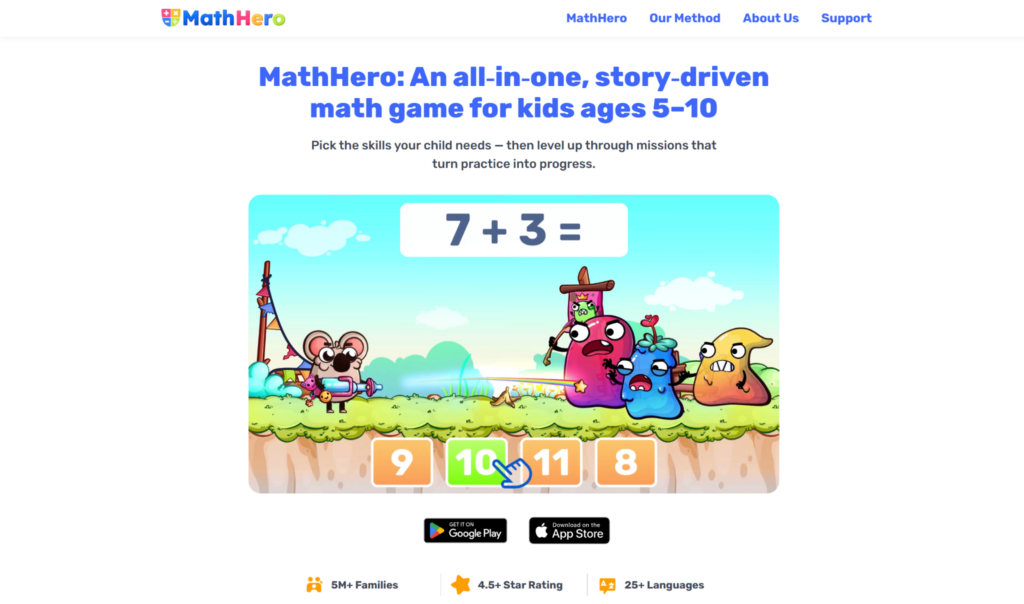
Quick answer: The best math apps for kids in 2026 turn practice into something children actually want to do, match the child’s skill level, and give instant feedback. Our top pick for K-4 arithmetic is MathHero, a story-driven math game where solving problems is the gameplay. Free math games like Khan Academy Kids and Moose Math suit the youngest learners, while SplashLearn, IXL, and DoodleMath work well as curriculum aligned practice for elementary school students.
Every teacher knows the moment. You hand out a worksheet and half the room deflates. Then the same child picks up a tablet and solves twenty math problems without noticing. The right math app taps into that. The wrong one is a worksheet with louder sound effects.
This guide ranks the top math apps for kids for home and classroom use, from pre-K counting through elementary arithmetic. Each pick tells you who it fits, what it costs, and where it falls short. All prices below are accurate at the time of publication and can change, so check the app store or the app’s own site before you subscribe.
How we chose the best math apps for kids
We looked for math apps that build real basic math skills, not just screen time. Three things separated the strong picks: motivation that lasts longer than a novelty week, difficulty that fits the child’s skill level and grade level, and immediate feedback so mistakes turn into math learning, not frustration. Short, regular practice beats long, occasional cramming. Here is a fuller look at the best ways to learn math if you want the research behind that.
What the best math apps have in common
Here is what the best math apps for kids share, so you can judge tools we did not include.
Immediate feedback and adaptive difficulty
The best math apps for kids respond the instant a child answers, and the strongest use adaptive learning to adjust as the child improves. Immediate feedback separates useful math practice from a screen that just says “try again.”
Motivation built in, not bolted on
Stars and badges stuck on top of math drills wear off in days. A story, a character to grow, and things to earn keep a child coming back. The question for any app: whose idea is the next session, yours or the child’s?
A real free math app tier and fair pricing
A free tier should show real content, not a two-minute demo. Some of the best math apps for kids are fully free; others give a trial, then charge a subscription. Know which you are getting before a payment popup surprises you.
1. MathHero: a game kids ask to play
MathHero is a story-driven adventure where solving math is how you play, not a reward you unlock after the boring part. Kids build a world, race, battle, and rescue characters, and every step runs on short sets of math facts. Children do a lot of math without noticing, and many who dread worksheets end up asking to play.
It covers the core of elementary arithmetic: addition and subtraction within 10, 20, 100, and 1000, times tables, and division. Roughly ages 5 to 10, or grades K-4. You choose the topic and difficulty, pick typed answers or multiple choice, and set the monster speed, so the same math game fits a cautious five-year-old or a fast third grader. Each profile keeps its own topics and difficulty, so siblings or students at different levels can share one app.
Honest limits: MathHero starts at a child’s first addition within 10. It does not teach number recognition or counting from scratch, and has no video lessons that explain a concept step by step. If a child is still learning to count, start with Khan Academy Kids or Moose Math, then return once they are ready for addition.
The whole game is completable for free, with no ads, at a pace of five levels a day. That cap matches how math practice works best: short, regular sessions. A subscription with a free trial removes the daily limit; check the app or site for pricing.
Ratings: Google Play 4.6 (46k) and App Store 4.7 (11k).
Best for: K-4 arithmetic, reluctant or math-anxious kids, and classrooms that want control over what each child practices.
2. Khan Academy Kids: best free app for ages 2 to 8
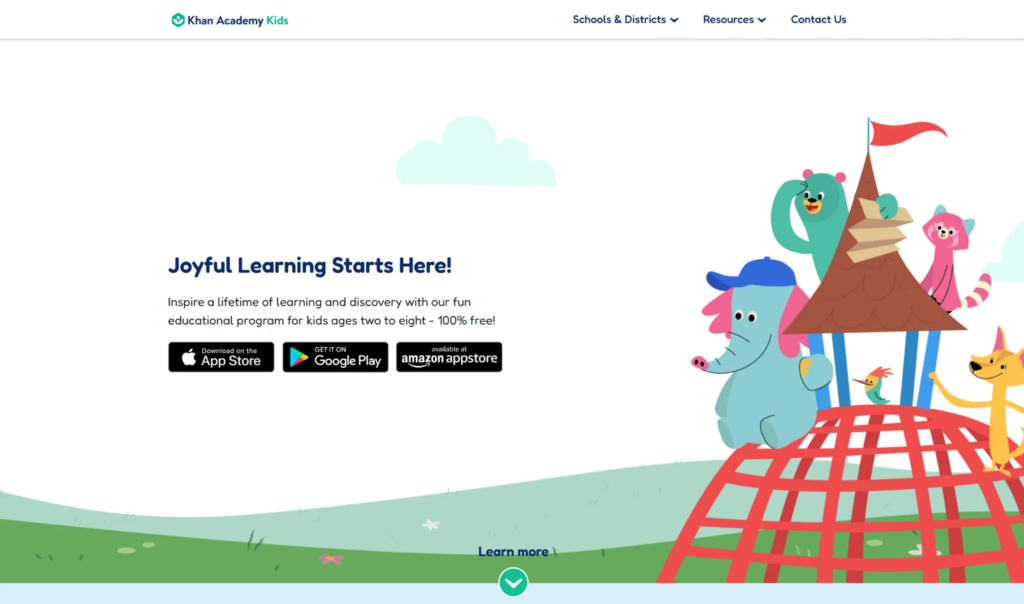
If you want quality at zero cost, start here. Khan Academy Kids is completely free, with no ads and no subscriptions, built for young kids ages 2 to 8. It covers early math concepts like counting, shapes, addition, and subtraction alongside reading, with personalized learning resources and animal characters that guide independent learning. For older students, the main Khan Academy platform adds instructional math videos and practice for every grade level, also free.
The trade-off: it leans more educational than game-like. As a free entry point into basic math concepts, it is hard to beat.
Price: Free. Best for: preschool and early elementary students, and anyone who wants a free app.
3. SplashLearn (formerly Splash Math): standards-based PreK-5 practice
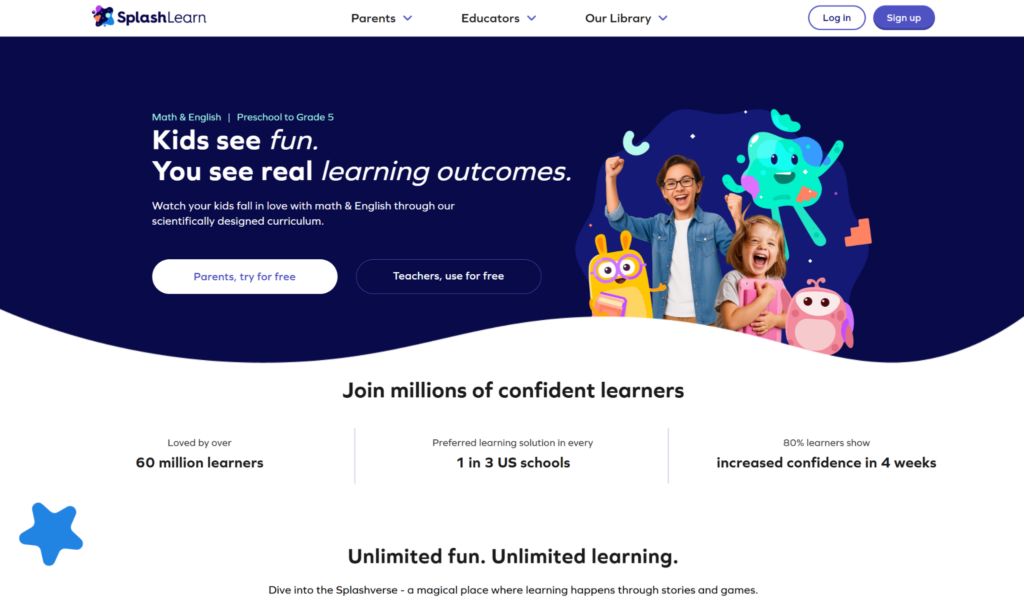
SplashLearn is a game-based math learning program covering math and reading from PreK through Grade 5, with a library of more than 4,000 interactive math games and worksheets. Its adaptive learning path adjusts to each child, and it is free for teachers and schools to use with a class, a real advantage for elementary school classrooms. Families get a free tier plus a premium subscription with a 7-day trial. Splash Math grew into SplashLearn, so older reviews may use the old name.
Price: Free for teachers and schools; family premium by subscription with a 7-day trial. Check current pricing. Best for: elementary students, and teachers who want to assign practice and watch student progress.
4. Prodigy Math: fantasy-based math game for grades 1-8
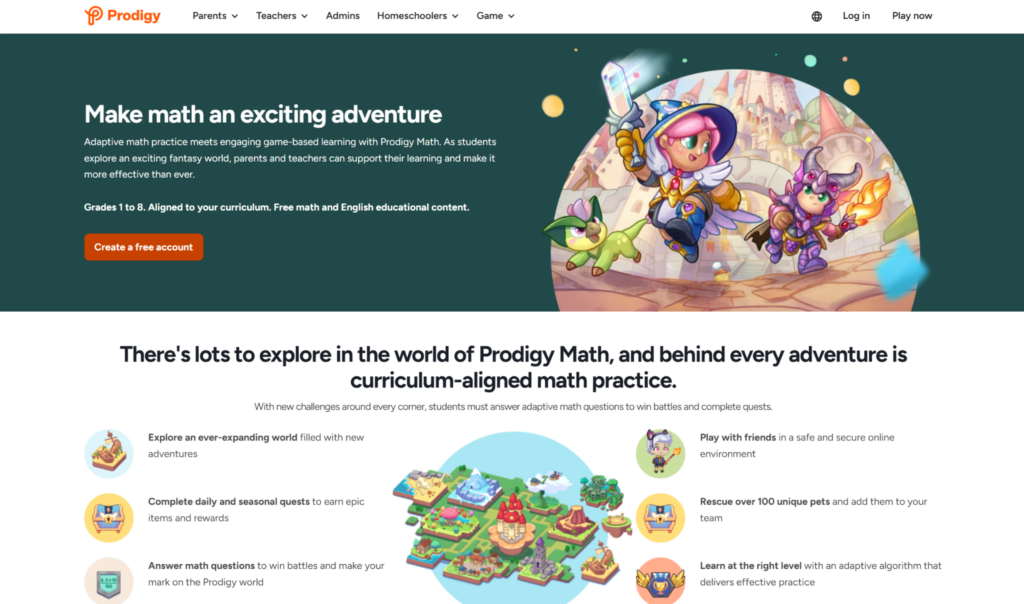
Prodigy Math is a fantasy based math game where kids battle and quest through curriculum aligned questions for grades 1 through 8. The core math content is free; an optional membership (the Core tier starts around $9.95/month) adds in-game extras, not more math. Like MathHero, it builds motivation into the world instead of stapling rewards onto drills. The catch is the in-game store, which pushes upgrades harder than some parents like.
Price: Free to play; optional membership from about $9.95/month, subject to change. Check current pricing. Best for: grades 1-8, and kids who love math games and game worlds.
5. Moose Math: best free pick for the youngest learners
Part of the Khan Academy family and completely free with no ads or in app purchases, Moose Math guides ages 3 to 7 through five mini-games covering counting, addition, subtraction, sorting, and geometry, all aligned to Common Core. Parents and teachers get a Report Card to monitor student progress. It is narrow by design and stops before multiplication, so treat it as a starting point, not a full K-5 program.
Price: Free. Best for: young learners meeting their first numbers and basic math skills.
6. Monster Math 2: story-driven arithmetic practice
Monster Math 2 wraps basic arithmetic in an adventure with characters and a story, covering more than 60 math concepts across grades K-5, with printable offline activities. You pick the skills your child works on, and a companion parent connect app lets you follow progress. It is free to start, with an optional subscription for full content.
Price: Free to try; optional subscription. Check current pricing. Best for: grades K-5 who respond to a narrative more than plain math drills.
7. Marble Math Junior: hands-on maze game for ages 5-8
Marble Math Junior turns math problems into mazes: kids roll a virtual marble to collect the right answers while practicing counting, addition, telling time, and money across three difficulty levels. It is playful and tactile, a nice change from traditional flashcards. It lacks adaptive difficulty and a detailed progress dashboard, so it is more practice-and-play than a tracking tool. It is a one-time purchase (around $3.99 on the App Store), so confirm the current price before you buy.
Price: One-time purchase, about $3.99. Check current pricing. Best for: kids ages 5 to 8 who learn by doing.
8. DoodleMath: adaptive daily practice for K-5
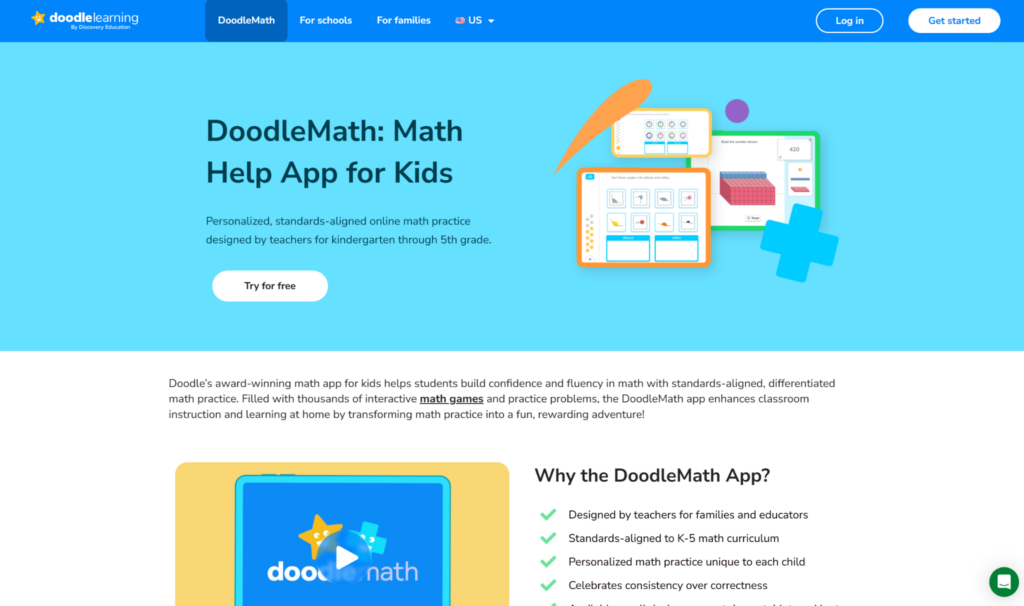
DoodleMath builds a personalized daily set of practice exercises for each child, tailoring math content to their strengths and weaknesses across grades K-5. Short, self paced daily sessions are the model, with a companion app and parent dashboard. US pricing runs $10.99/month or $94.99/year for one child, with a 7-day free trial; family plans cost more.
Price: From $10.99/month or $94.99/year for a single child, with a 7-day trial. Check current pricing. Best for: families and teachers who want short, consistent daily practice.
9. Elephant Learning: structured practice with coaching
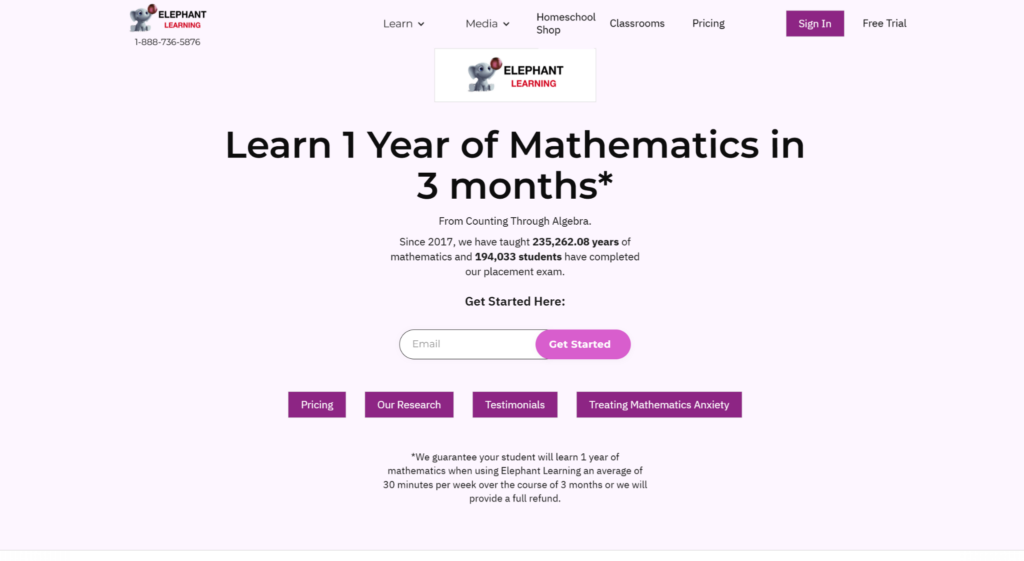
Elephant Learning, also written Elephant Learning Math Academy, is an adaptive subscription program for ages 2 to 16 that the company says helps children learn a year of math in about three months. Plans run about $35/month for up to three students, with live coaching calls. It is more clinical than playful. That “year in three months” claim is the company’s own, not independent research, so treat it as a promise to test.
Price: About $35/month for up to three students, subject to change. Check current pricing. Best for: filling gaps with a guided approach and personalized instruction.
10. IXL: comprehensive, standards-based skill practice
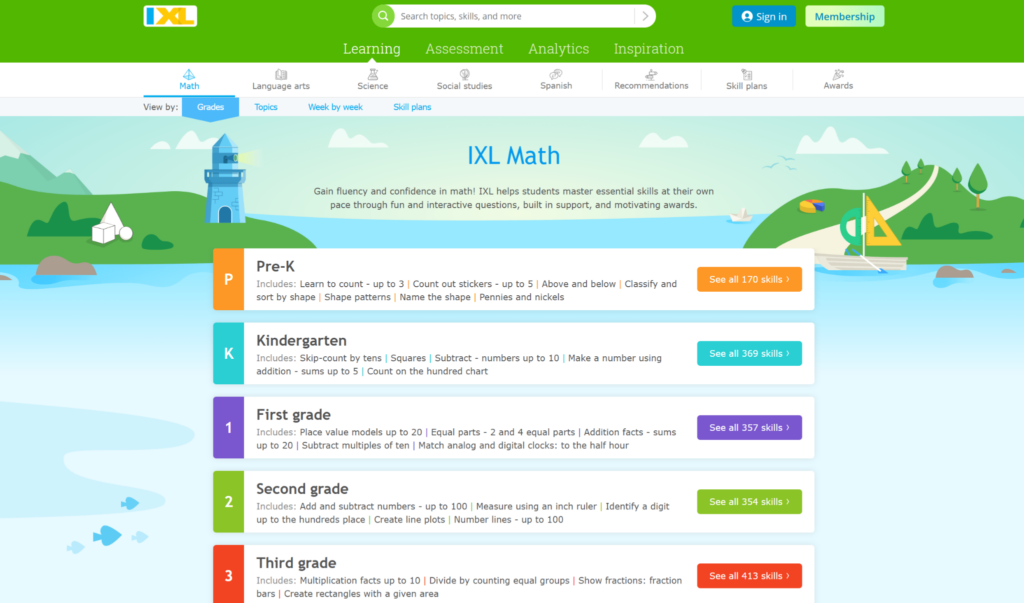
IXL is a deep practice platform covering math from pre-K to 12th grade, with a diagnostic that gives personalized skill recommendations and analytics for parents and teachers. It is thorough and curriculum aligned, which is why so many schools use it with elementary, middle school, and high school students. It is practice, not instruction: it drills skills rather than explaining them, and the scoring can frustrate kids near the top. Family plans start at $9.95/month for a single subject and run to $19.95/month for core subjects.
Price: From $9.95/month (single subject) to $19.95/month (core subjects), subject to change. Check current pricing. Best for: elementary through middle school students who need broad coverage.
11. DragonBox: for going beyond arithmetic
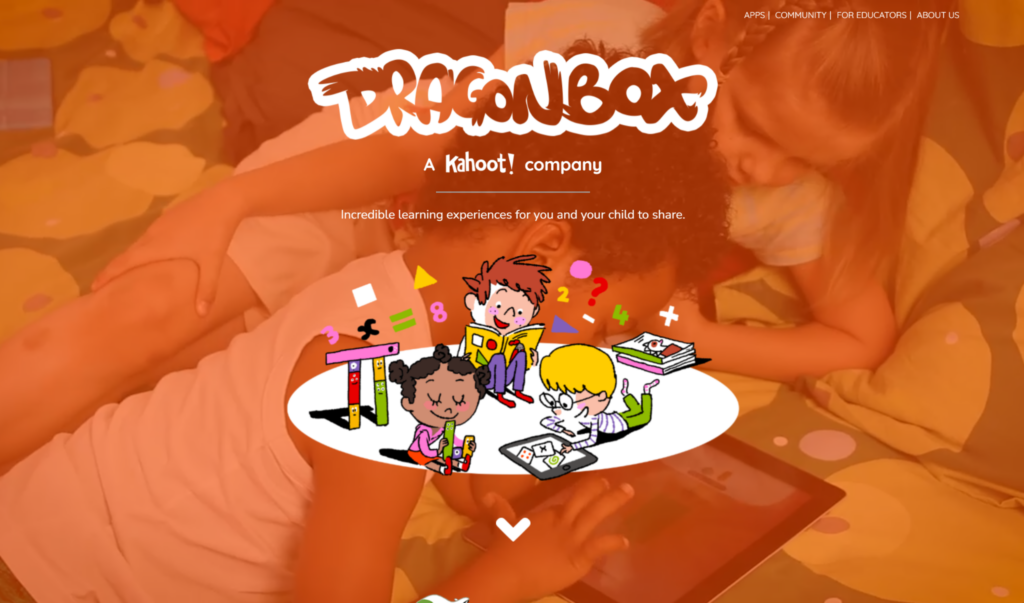
Once a child has arithmetic down, DragonBox introduces algebra and geometry through puzzles that teach the logic before the notation, building conceptual understanding and creative problem solving. It is a set of paid, one-time apps rather than a subscription. If your child needs geometry, equations, or topics past core elementary math, DragonBox fits better than an arithmetic app.
Price: Paid apps, one-time purchase. Check current pricing. Best for: kids ready for pre-algebra concepts and logical thinking.
More free math tools and math games worth a try
A few extras. The Math Learning Center offers free apps built on virtual manipulatives and visual models, like Number Pieces and Number Frames, that help kids see place value and basic operations. For times-table work, plenty of free math games exist, but pair any drill with something motivating so the skills stick.
How to choose the right math app for your child or class
Match the tool to the child, not the other way around. The best math apps for kids all pass one test: the child asks to come back.
Match skill level and grade level
Line the app up with where the child sits, not the grade level on paper. For a child still learning to count, Khan Academy Kids or Moose Math fit. Once they can start basic arithmetic, a title like MathHero or Monster Math keeps them moving. Look for visual models that make the math concrete.
Build math fluency, not just fun
Fun gets kids in the door; math fluency keeps the skills. Look for apps that push toward quick, accurate recall of math facts through spaced practice, which is what math mastery is built on. A game that is all reward and no real problem solving feels great and teaches little.
Fit apps into your math instruction
An app supplements math instruction; it does not replace it. Use it for practice, fluency, problem solving, and motivation, and read progress dashboards as a signal, not a grade. The apps that motivate students most let the child feel capable, so choose for confidence as much as content.
Common questions about math apps for kids
What is the best free math app for kids?
For ages 2 to 8, Khan Academy Kids is the strongest free option: no ads, no subscription, and broad early-learning content. Moose Math is another fully free pick for the youngest kids. MathHero is free to play through the entire game at five levels a day, enough for a short practice session.
Do math games actually build math skills?
Yes, when the math is the gameplay and not a gate between the fun parts. Game-based learning works because kids repeat skills willingly, and many who resist worksheets happily solve dozens of math problems inside a story and have so much fun they forget they are practicing. The test: does the app drive real practice or decorate it?
At what age should kids start using math apps?
Around ages 4 to 5, once a child recognizes numbers, apps for kids like Moose Math introduce counting and basic math concepts. Arithmetic-focused apps such as MathHero suit kids ages 5 and up, when first addition begins. Match the app to the skill, not the birthday.
Can a math app replace a teacher?
No. The best math apps for kids support classroom teaching; they do not replace the teacher who explains concepts, catches misconceptions, and knows the child. Use apps for practice, fluency, and motivation, and keep the teaching human.
Pick one app, watch how your child or class responds for a week, and let their reaction decide. The best math app for kids is the one they ask to open again.