
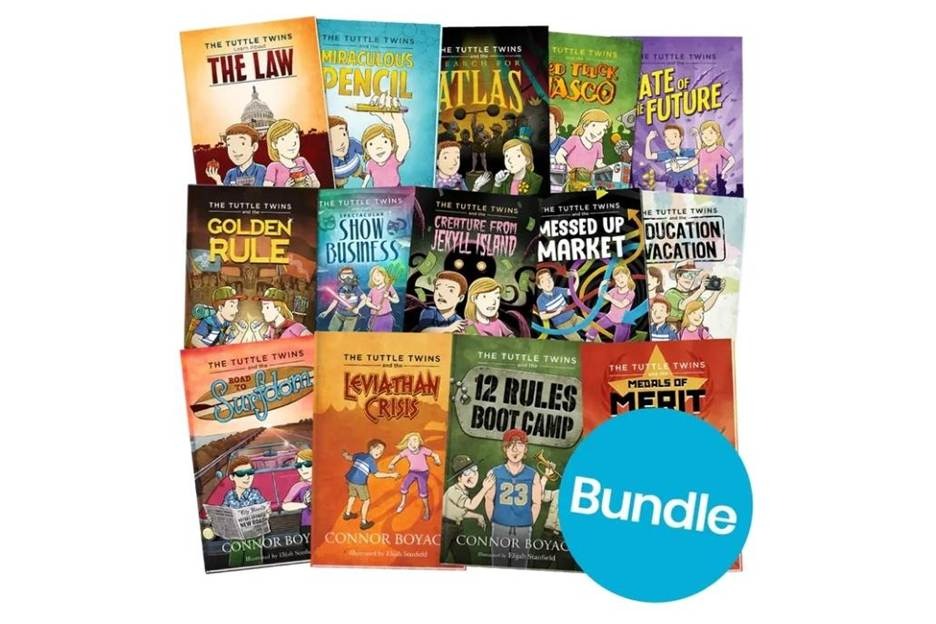
Tuttle Twins occupies a distinct place in the children’s education market. The United States brand uses illustrated stories to introduce economics, civics, history, entrepreneurship, and personal responsibility to children. Its central proposition is straightforward: subjects usually reserved for older students or adults can be translated into narratives that families can discuss together. That approach places the company within a wider movement toward parent-directed learning, values-based media, and educational materials used outside normal classroom hours.
A Children’s Series Built Around Complex Public Ideas
Connor Boyack, president of the Utah-based Libertas Institute, launched the series in 2014. The first books adapted ideas associated with classical liberal and free-market writers, including Frédéric Bastiat, F.A. Hayek, and Ludwig von Mises. Rather than presenting those works as theory, the books follow twins Ethan and Emily through problems involving laws, trade, money, property, incentives, and government power.
The product range now extends beyond the original illustrated books for children aged about five to 12. It includes board books for ages zero to four, history volumes, graphic novels, teen fiction, guidebooks, audiobooks, economics curricula, workbooks, and parent guides. The teen range includes branching, consequence-based stories and guides covering entrepreneurship, logical fallacies, bias, courage, and historical figures.
Storytelling Makes Abstract Lessons Easier to Discuss
The brand’s clearest point of difference is its use of recurring characters and fictional situations. Inflation may appear through changing prices. Entrepreneurship may emerge through a food-truck dispute. Property rights and law become conflicts that Ethan and Emily must understand before resolving them.
This framework addresses a practical difficulty for parents: many adults value financial or civic education but don’t feel prepared to teach it. Tuttle Twins parent guides provide background on the original works, explanations of common misconceptions, suggested discussion answers, and further resources. The result is less like a conventional textbook and more like a structured conversation starter. Internally, the company calls this outcome the “Dinner Table Moment”.
The method also aligns with broader research on narrative communication. A Stanford resource featuring behavioral scientist Jennifer Aaker states that “stories are remembered up to 22 times more than facts alone.” While that figure doesn’t prove the effectiveness of any specific Tuttle Twins title it explains why the company organizes difficult material around characters, conflict, and consequences rather than lists of definitions.
Materials Span Preschool Through the Teen Years
Tuttle Twins has developed age-based entry points instead of relying on one format. Its preschool materials cover early literacy, numbers, shapes, colors, and social-emotional themes such as helping and liberty. Families examining that range can find the current collection at tuttletwins.com. The toddler books use ABC and 123 structures, while the core illustrated series introduces more detailed economic and civic questions.
For older children, the company offers American history volumes, teen novels, guidebooks, and an academy product. Bundles group materials by age or purpose, including starter, toddler, teen, and multi-age family sets. This structure suits households with several children because one purchase can cover different reading levels while maintaining common themes.
Supplementary workbooks and guides also make the books easier to use in homeschool lessons or after-school study. The company’s own customer data suggest that this second use case matters greatly: 78 per cent of its families reportedly send their children to public school. Leadership has projected that homeschool customers may eventually represent only about 20 per cent of revenue, despite the brand’s strong recognition in that market.
Financial Literacy and Critical Thinking Address Parent Concerns
Tuttle Twins positions its content as preparation for decisions that children will face beyond school. Financial literacy receives particular attention through lessons on prices, inflation, trade, saving, business creation, and monetary policy. Entrepreneurship is framed as identifying problems and creating value, while critical-thinking titles examine bias, fallacies, persuasion, and competing accounts of history.
Internal audience research cited by the brand says 90 per cent of parents lack confidence that schools are preparing children for real-world success. The same research identifies financial literacy as the subject parents most want their children to learn. Those findings help explain the company’s mainstream reach. Mothers aged 24 to 54 reportedly account for about 78 to 80 per cent of purchases, while grandmothers form an important gift-buying segment. Many customers have multiple children ranging from toddlers to teenagers.
Geographically, sales are strongest across a broad “smile” of populous states, including California, Texas, Florida, Georgia, New York, and Pennsylvania. Texas is reported as the second-largest state market. This distribution complicates the idea that the series serves only a narrow homeschool niche.
A Clear Worldview Creates Both Loyalty and Scrutiny
The company states that its mission is to help parents teach “powerful ideas and true history.” Its books emphasize liberty, individual sovereignty, free markets, the non-aggression principle, and personal responsibility. That clarity gives families an identifiable framework, but it also creates the brand’s main editorial limitation: the material isn’t ideologically neutral.
Critics argue that the series can simplify disputed historical and economic questions or present libertarian conclusions as settled fact. International coverage of the animated adaptation has likewise documented debate over whether values-driven children’s media educates or indoctrinates. Supporters answer that conventional schooling and entertainment also carry assumptions, making transparent alternatives legitimate.
For families, the practical question is therefore one of fit and use. The books offer accessible explanations, consistent values, and tools for discussion. They work best when adults treat them as a starting point, compare claims with other sources, and invite children to question conclusions. In a growing market for parent-led educational media, Tuttle Twins stands out not because it avoids ideology, but because it states its position openly and builds a broad product system around it.